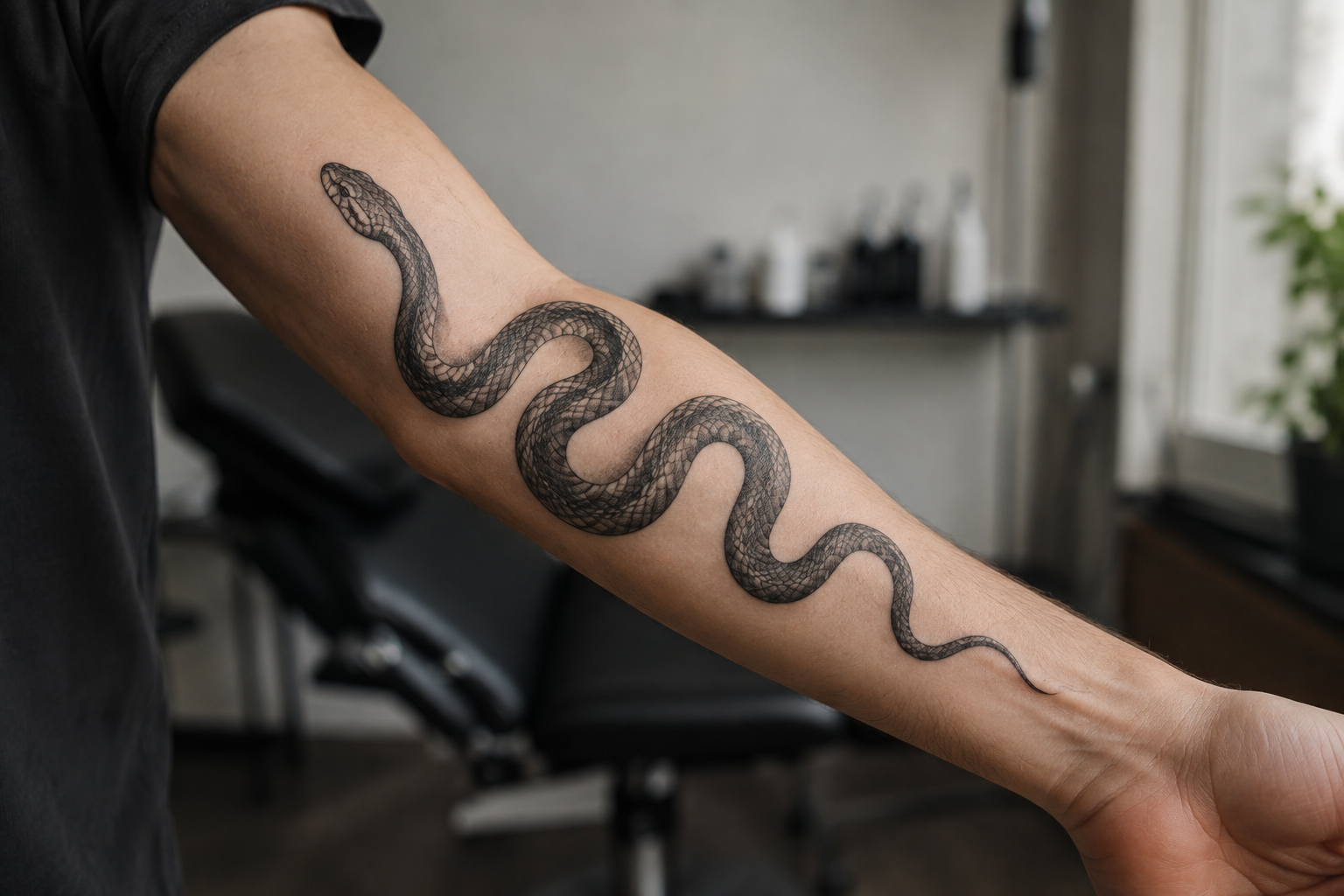
What can a snake tattoo mean?
A snake is associated with change, renewal, protection, knowledge, danger or strength. The interpretation depends on culture, era, additional elements and personal context. There is no single meaning that automatically describes every snake tattoo.
Snakes often appear together with other symbols: a rose, a dragon, a phoenix, a dagger or a skull. Each pairing shifts the meaning, so you will find many of these combinations in the gallery below.
If the symbolism matters to you, separate your own meaning from decoration. Decide whether the snake should look calm, dynamic, threatening or neutral. The position of the head, an open mouth and the way the body coils change the impression more than any definition added at random.
First, choose the movement of the composition
Head, scales and tongue: how much detail do you really need?
The head is usually the smallest and at the same time the most recognizable part. In a small design, adding eyes, fangs, a tongue and many tiny scales quickly becomes a problem. The silhouette and the rhythm of the body have to work first.
Scales can be a full pattern, a simplified accent, or appear only in selected parts of the body. The smaller the tattoo, the more important the spacing between lines. In a small design, fine scales tend to blur together over the years, so keep them simple.
Forearm and calf
These are natural places for an elongated motif. On the forearm, decide whether the composition should read with the arm hanging down, turned inwards or shown from the side. Do not put all the important elements only on the side that faces the camera.
The calf gives a larger surface and lets the artist vary the thickness of the snake’s body more. In both places, look at the stencil from the front, from the side and in motion.
Upper arm, thigh, ribs and back
The upper arm and thigh suit a coiled form or a composition with a flower, skull or dagger. The ribs allow a long, flowing movement, but the design should account for breathing and twisting of the torso. The back gives room for a larger scene, so before you start, decide whether the snake will be a standalone piece or the axis of a future, bigger project.
Realism, traditional outline or ornament?
A realistic snake needs room for light, shadow and anatomy. Traditional style simplifies the body and uses a bolder outline and clear fields of color. In an ornamental version the animal can become a rhythm of lines, but it should still keep a recognizable structure.
When choosing an artist, look for similar compositions on the same body part in their portfolio. Being able to draw a snake on paper is not the same as leading it around a forearm.
Snake tattoo in different styles: 6 variations
The same motif can look completely different depending on the technique. Style affects not only the character of the tattoo, but also the minimum size, the session time and how the design ages on the skin.
Fine line snake
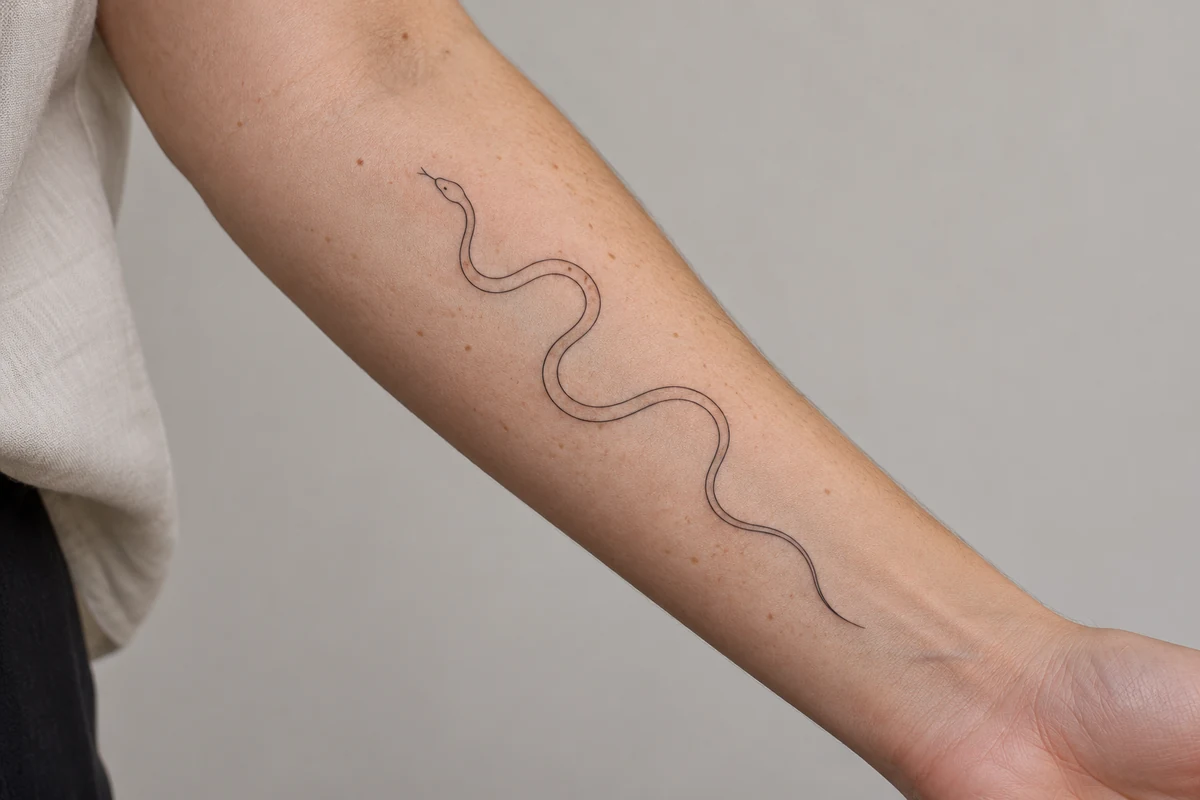
A single thin line, minimal detail, often no scales. This is the most popular choice for a delicate, feminine snake tattoo. It works best when the body has a clear, fluid movement, for example an S-curve along the forearm. Avoid squeezing tiny scales into a very small design, because over time they will blur into a grey patch.
Ornamental and dotwork snake
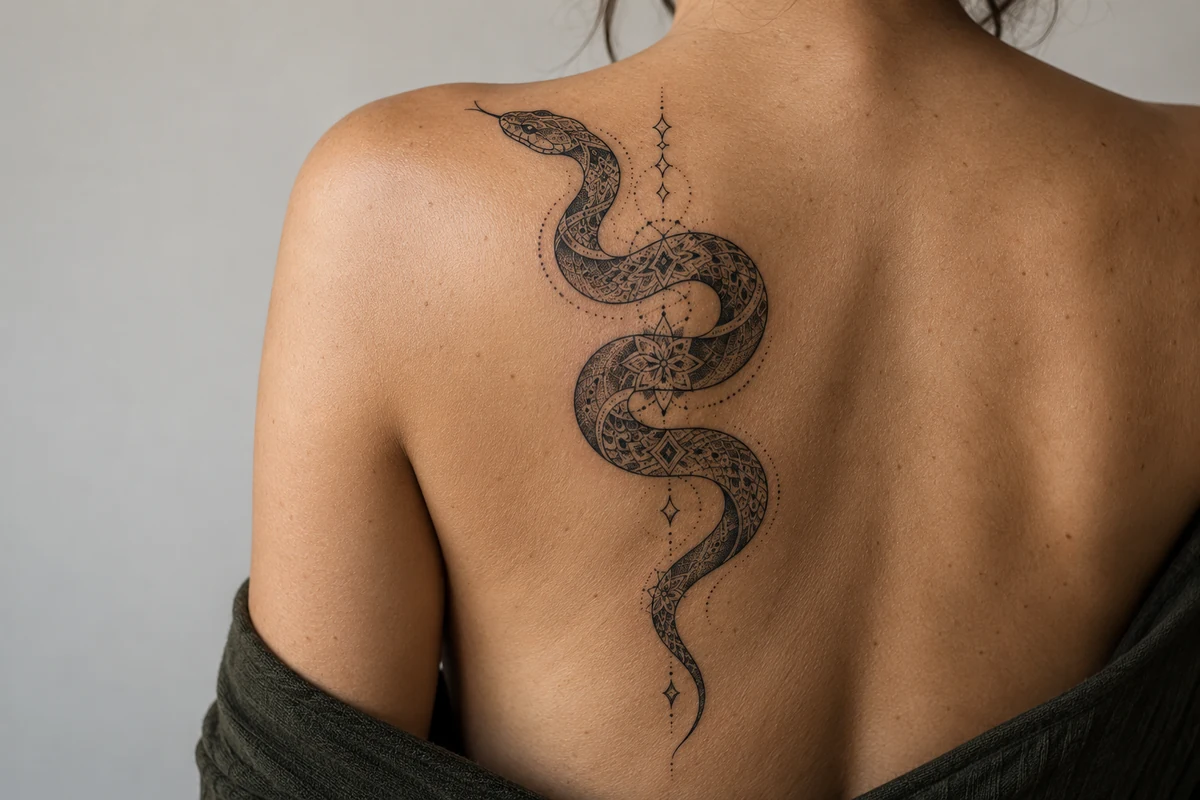
Scales turned into a pattern of dots, geometric fields or mandala motifs. This style likes longer, symmetrical areas: the spine, the shoulder blade, along the ribs. Dotwork usually heals gently, but it needs a larger format than fine line for the ornament to stay readable.
Japanese style snake
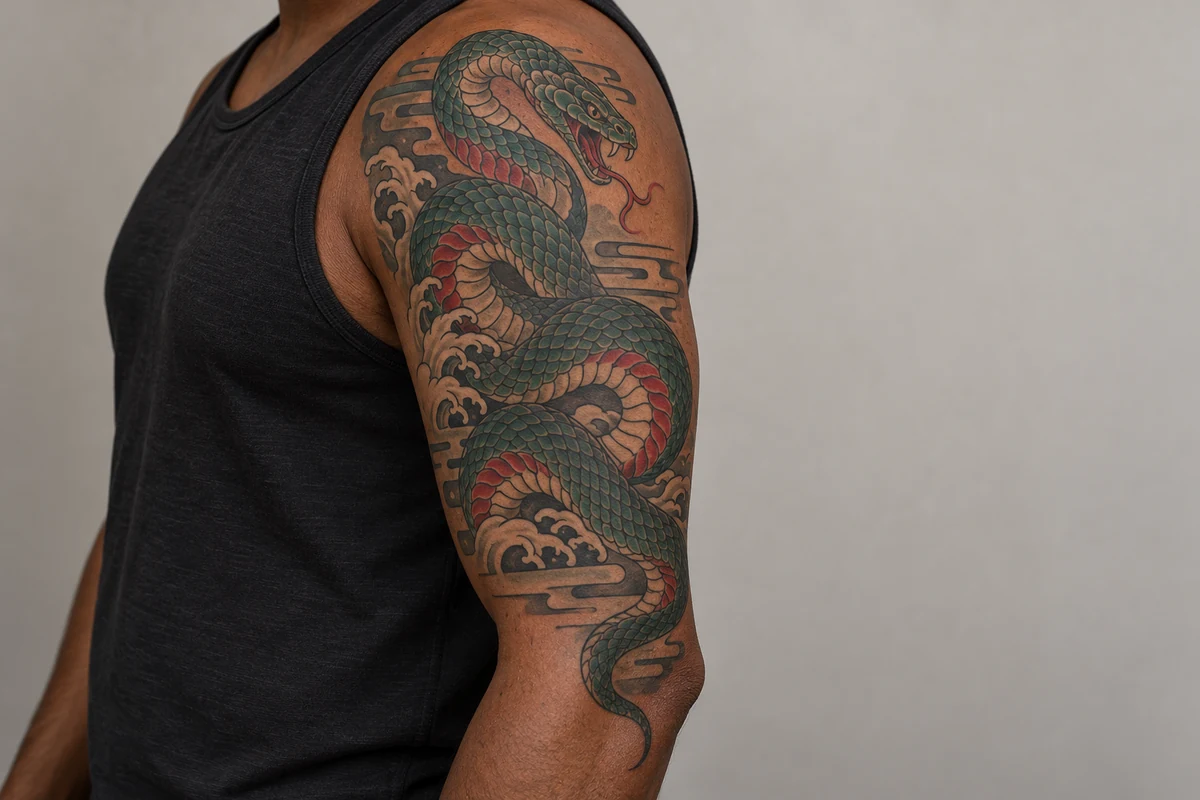
In Japanese tradition the snake (hebi) is linked with protection, transformation and good fortune, often together with waves, cherry blossoms or peonies and a wind-bar background. This is a style for large areas: the upper arm, thigh or back. Bold outlines and full color keep the design readable for a long time, but it takes several sessions.
Snake with flowers
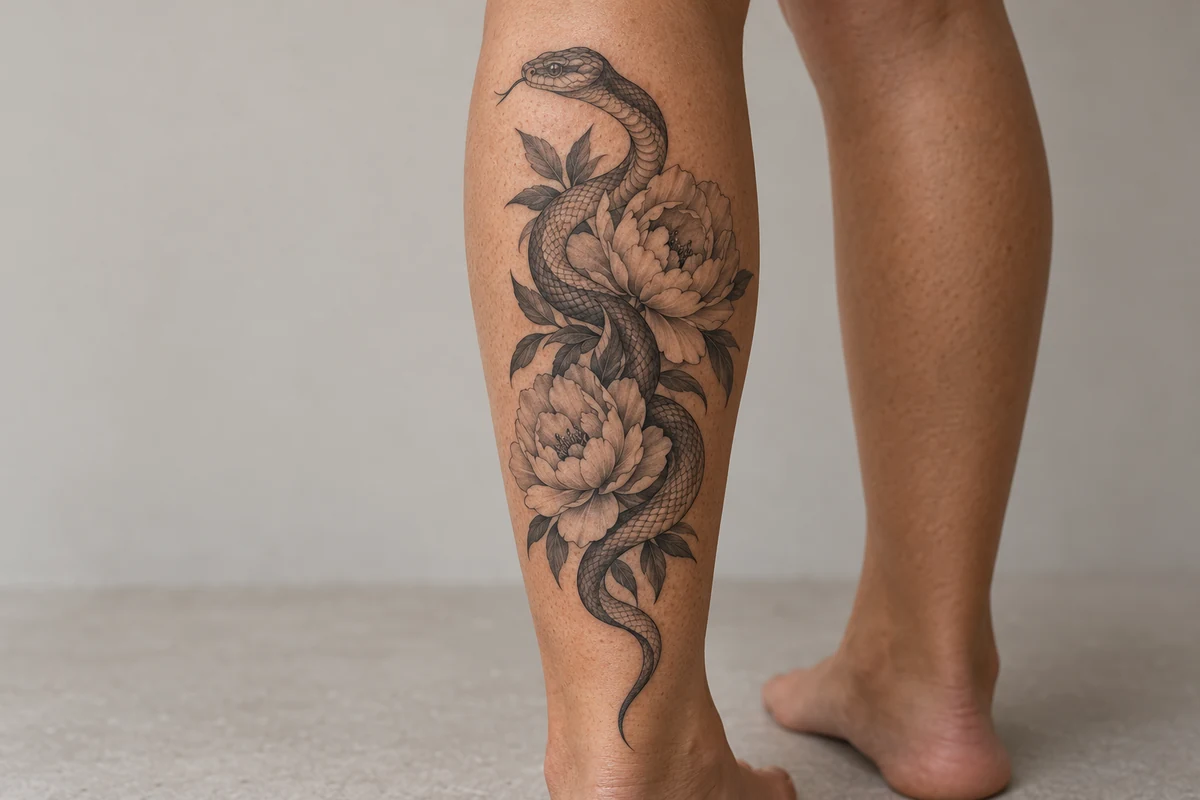
Pairing a snake with a rose, peony or lily softens the predatory character of the motif. A popular reading is beauty and danger, rebirth after a hard time, or protecting what is fragile. Black and grey with soft shading looks great on the forearm and calf.
Snake wrapped around the forearm
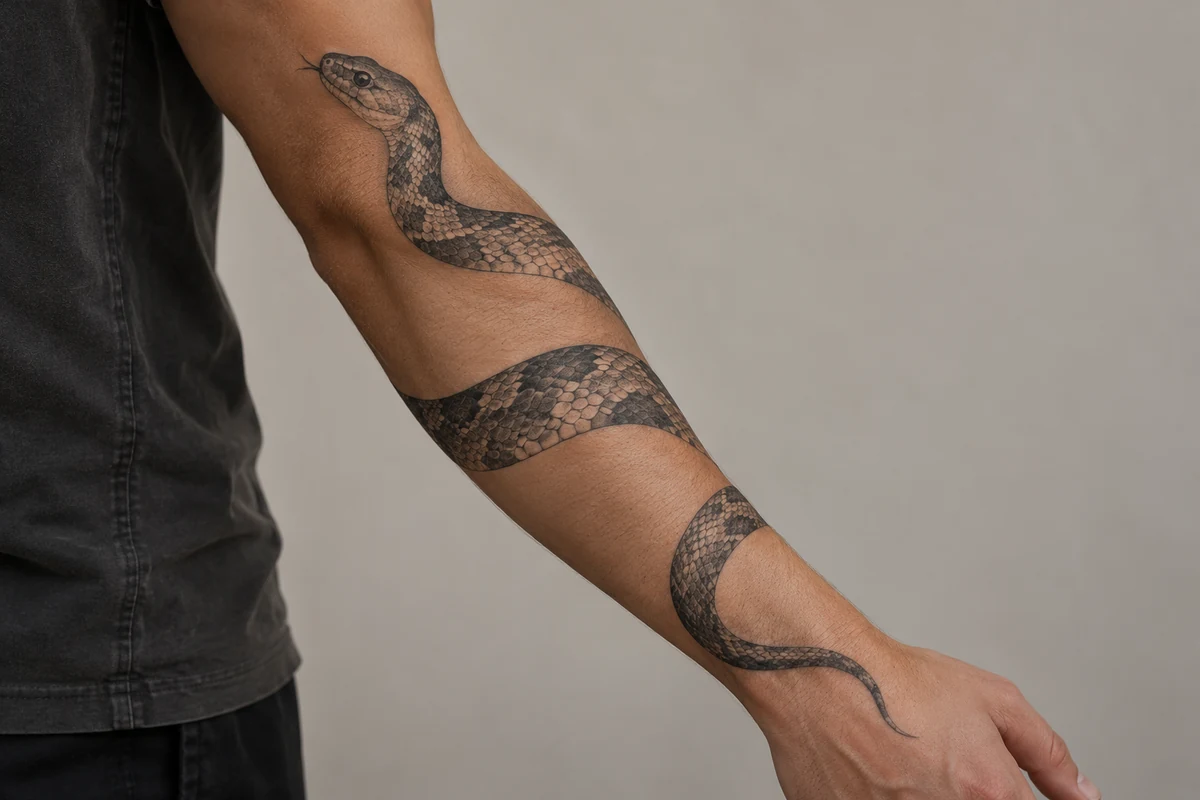
A spiral around the arm is one of the most striking compositions, but also the hardest. The design has to work from every side, and the artist usually draws it freehand or transfers it in several stencils. Plan it where the arm does not change its circumference much, between the wrist and the elbow.
Snake on the ribs
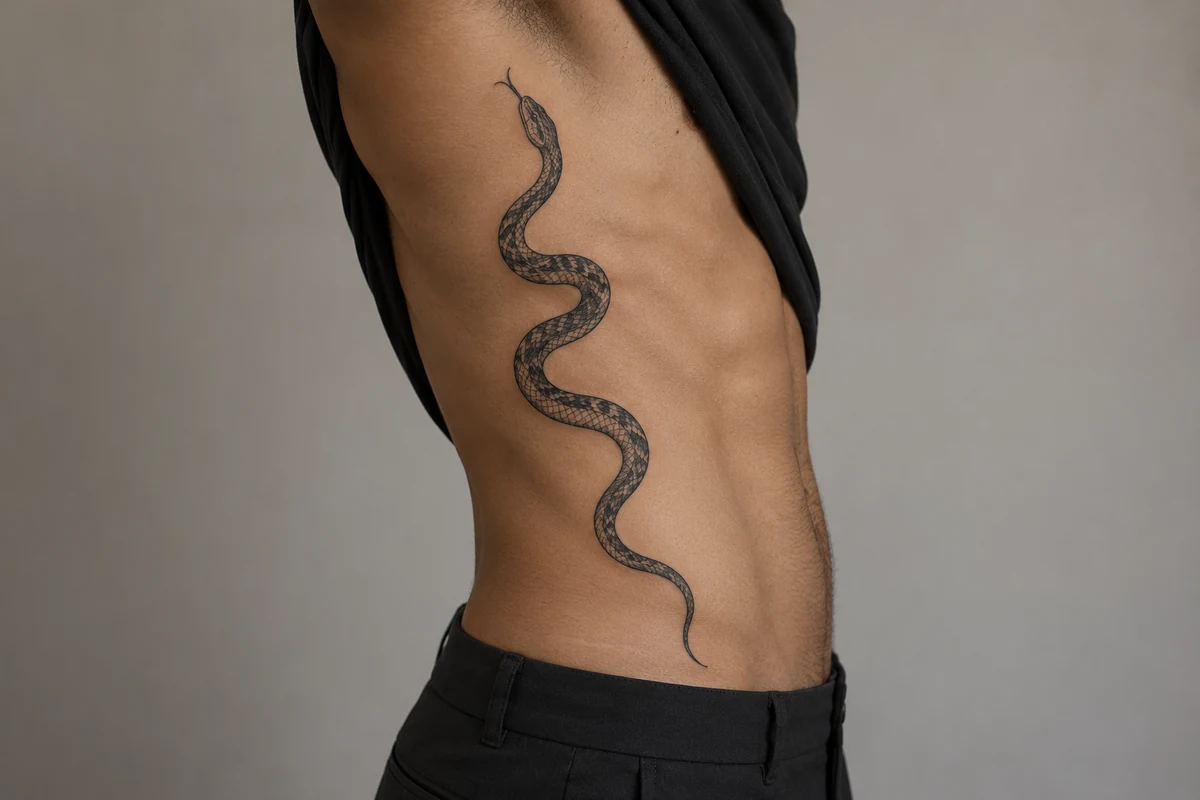
The long body of a snake naturally follows the line of the side, from the armpit towards the hip. This spot hurts more, because the skin sits close to the bone and breathing moves the surface. In return, the composition looks very elegant and is easy to cover.
44 more snake tattoo designs with photos
Below are 44 snake tattoo visualizations, from micro designs for the wrist to large compositions for the back and thigh. They are grouped by size, style and the motifs a snake is most often combined with.
Small snakes: wrist, ear, finger, ankle, neck: 7 designs
7. Small snake on the wrist
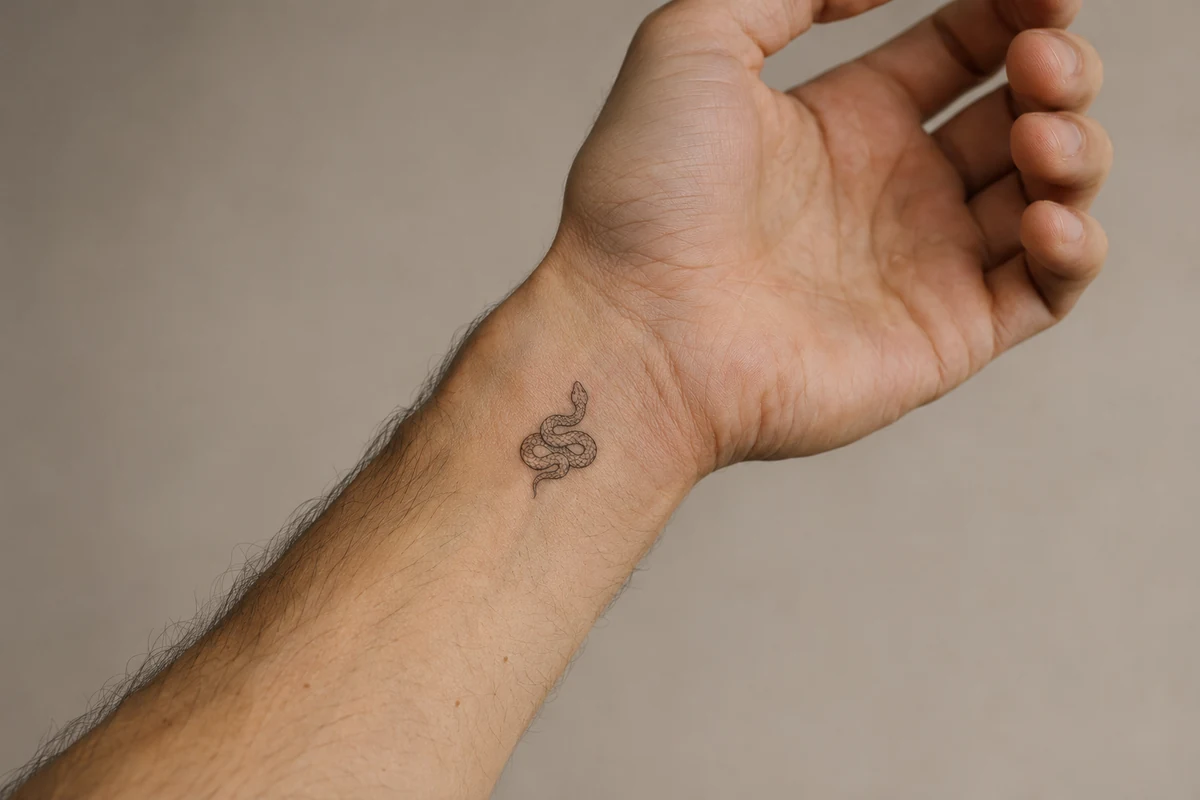
The design is about 2 cm, so the session takes a few minutes. Net-like scales add detail, but at this size the lines need enough spacing.
Symbolism: A small snake on the wrist is an everyday reminder of a change you always have in front of you.
8. Snake behind the ear
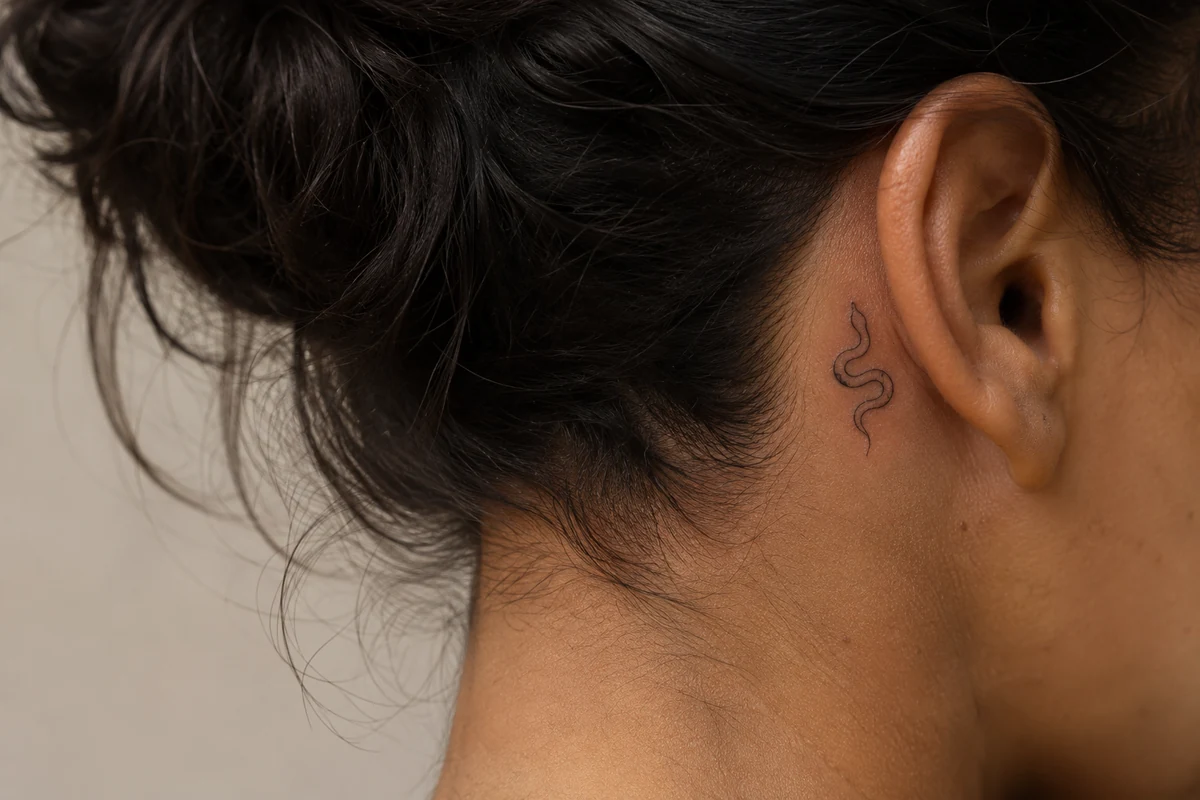
A single thin wavy line. Behind the ear, the tattoo is easy to hide under loose hair.
Symbolism: A snake behind the ear is a discreet symbol of intuition and protection, visible only when you want it to be.
9. Snake anklet
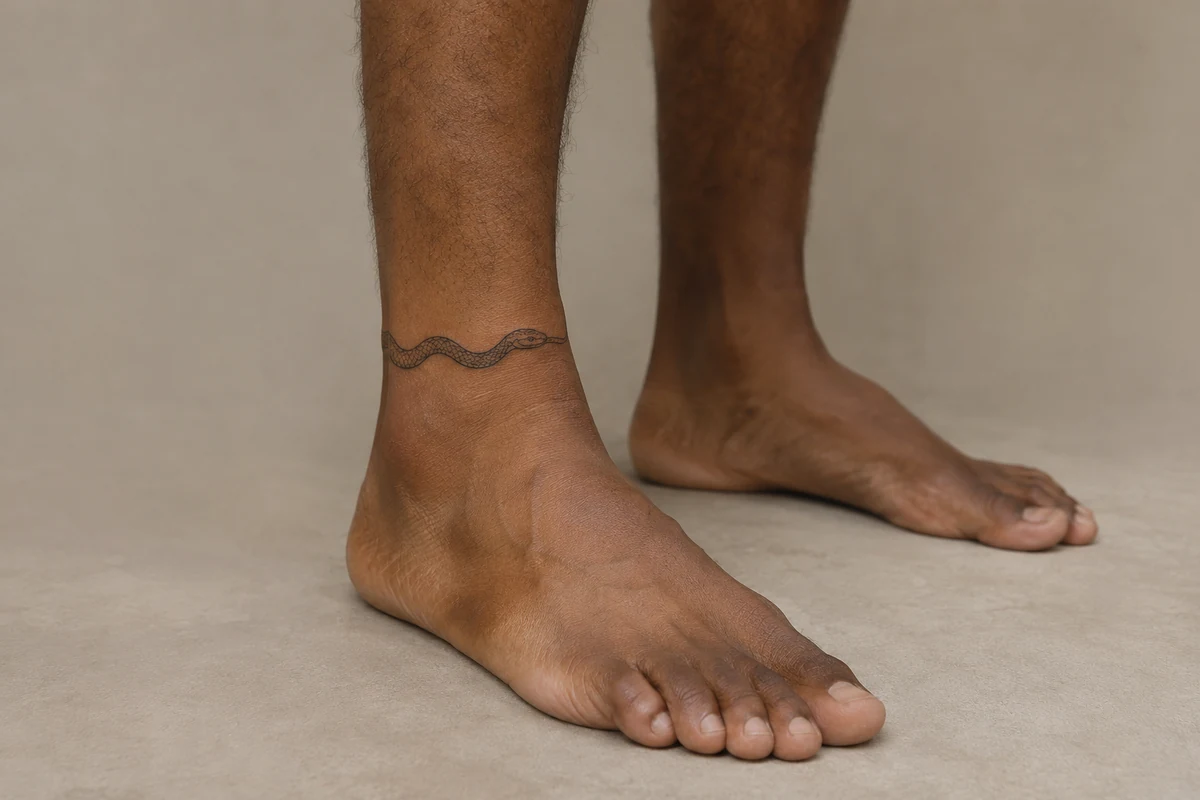
The snake runs horizontally above the ankle and closes like a chain. It looks great with sandals and bare feet.
Symbolism: A snake anklet stands for protection and a cycle that closes in one circle.
10. Snake along the collarbone
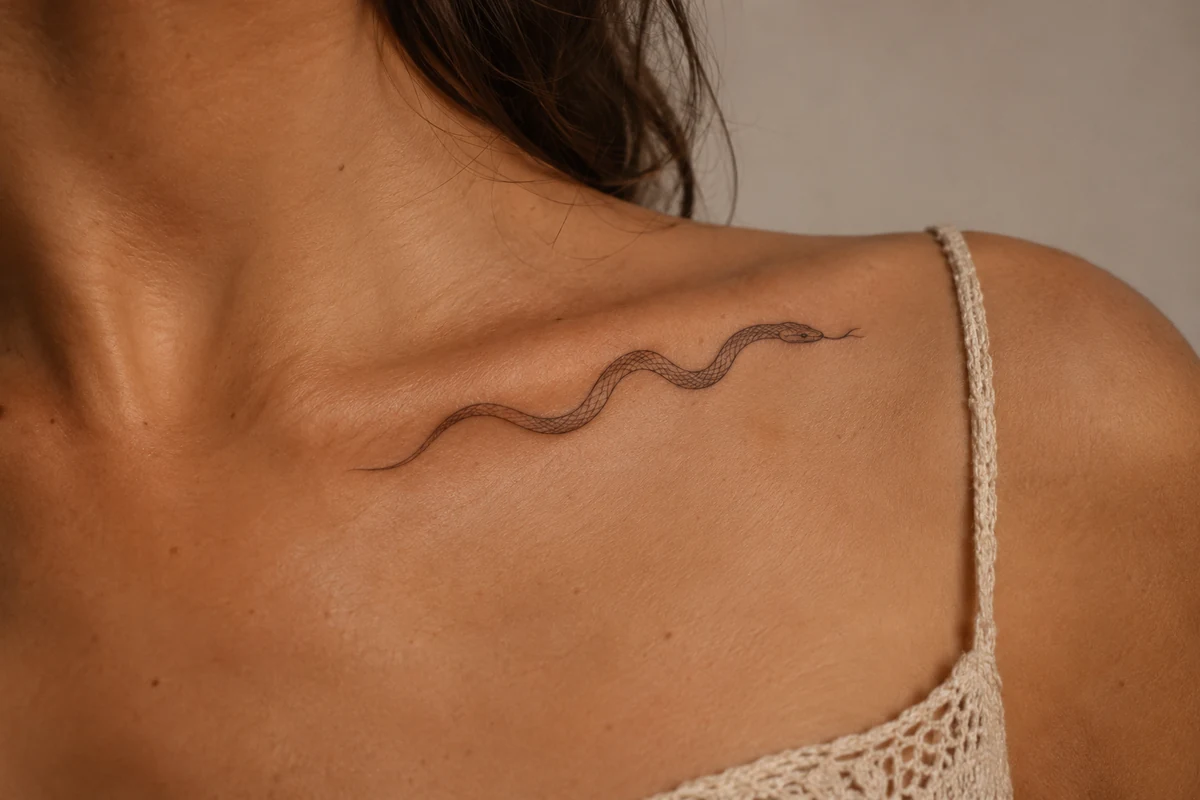
The snake follows the line of the bone, from the shoulder towards the breastbone. The collarbone hurts more than the arm, but the design takes about an hour.
Symbolism: A snake on the collarbone stands for feminine strength and the courage to show your transformation.
11. Snake wrapped around a finger
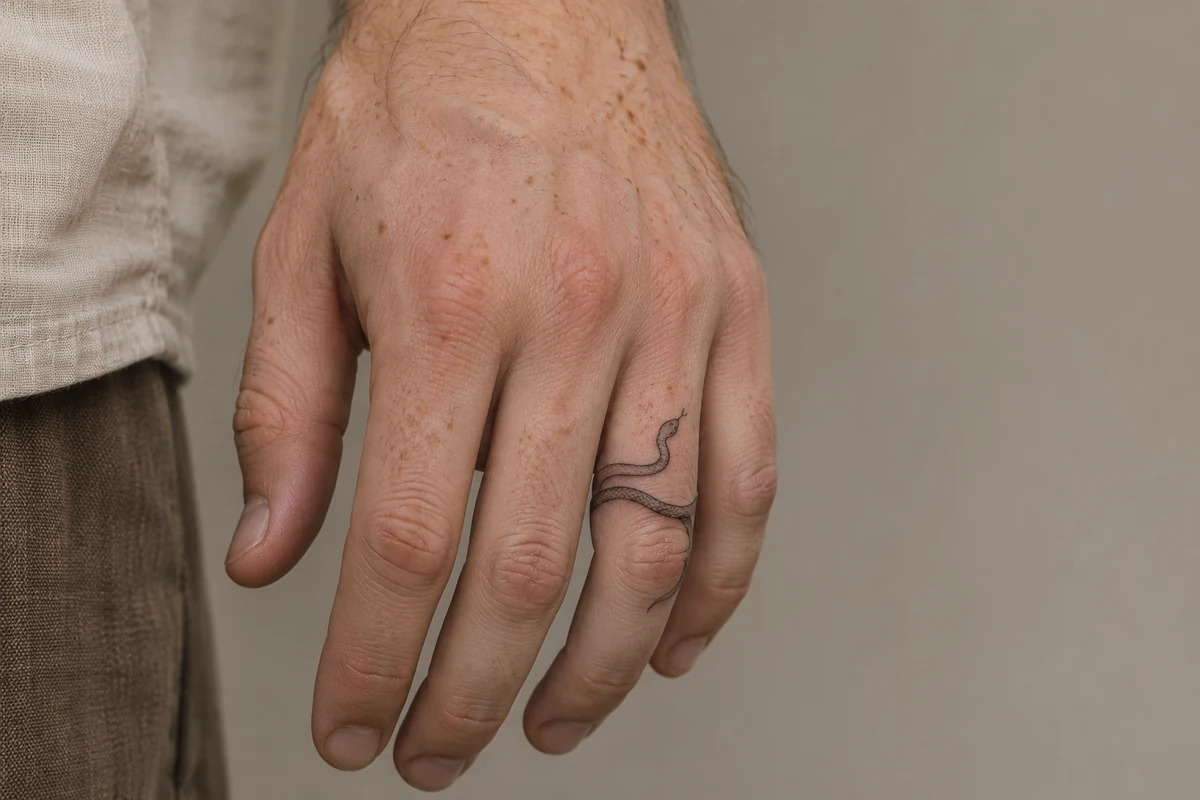
The tattoo looks like a ring. Lines on fingers fade faster, so expect a touch-up.
Symbolism: A snake ring is a promise made to yourself: I change, but I stay myself.
12. Vertical snake on the back of the neck
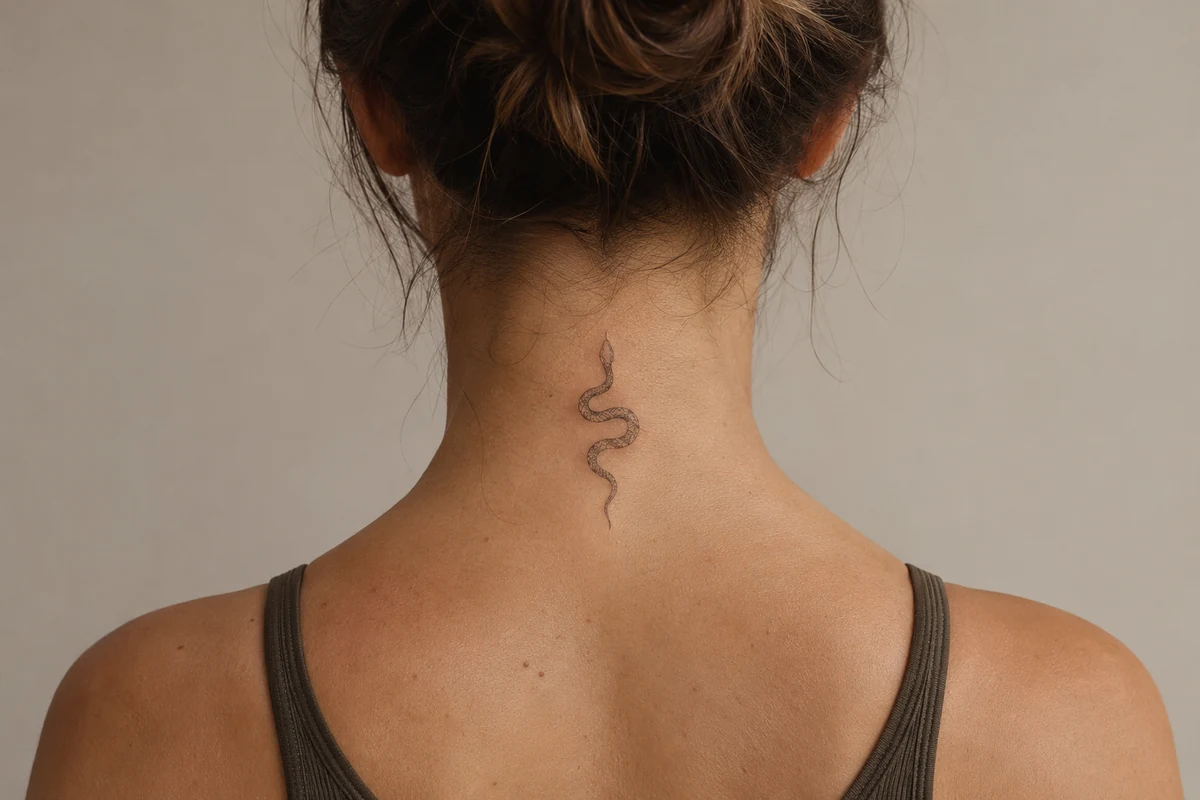
A vertical snake in the middle of the nape, about 5 cm long. With loose hair it is almost invisible.
Symbolism: A snake on the back of the neck protects your back, the part we cannot see ourselves.
13. Long snake from ankle to calf
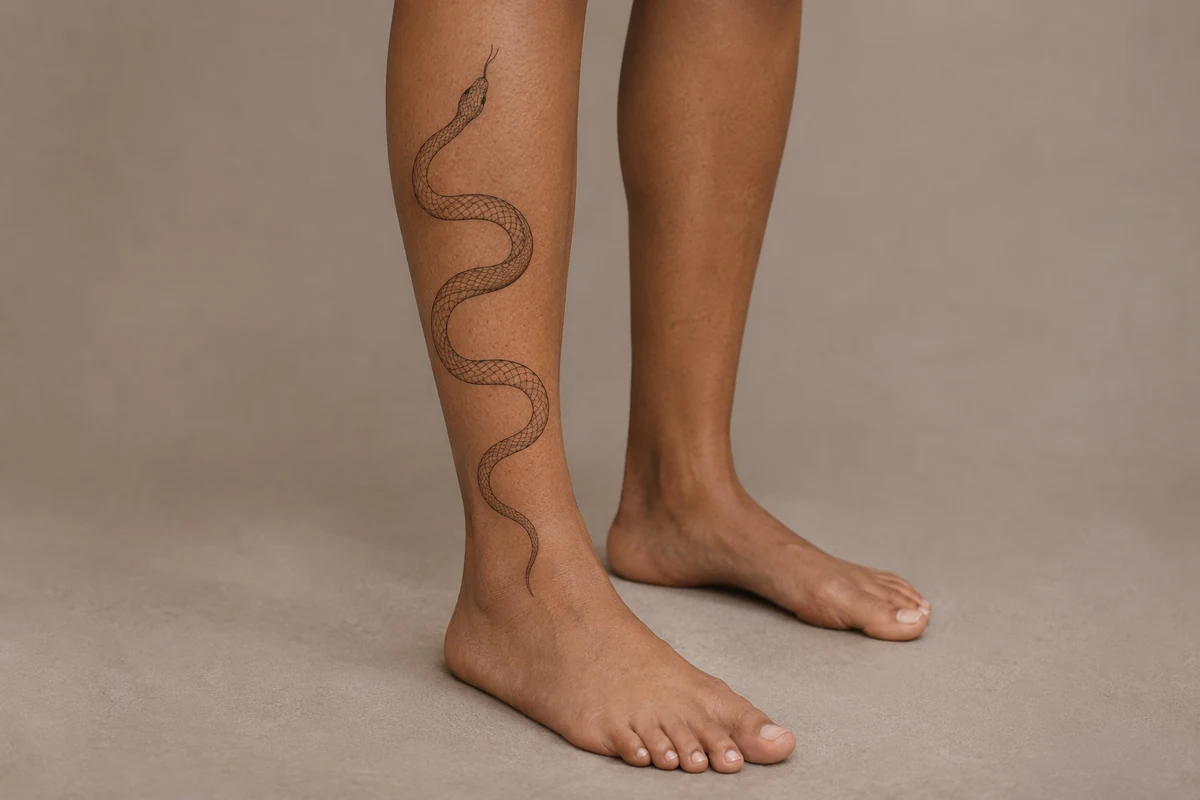
The snake starts at the ankle and rises along the shin. Fine line on the leg heals well and rarely fades.
Symbolism: A snake climbing up the leg stands for the way up and growth step by step.
Large snakes: thigh, calf, back, upper arm, neck: 9 designs
14. Cobra with a spread hood
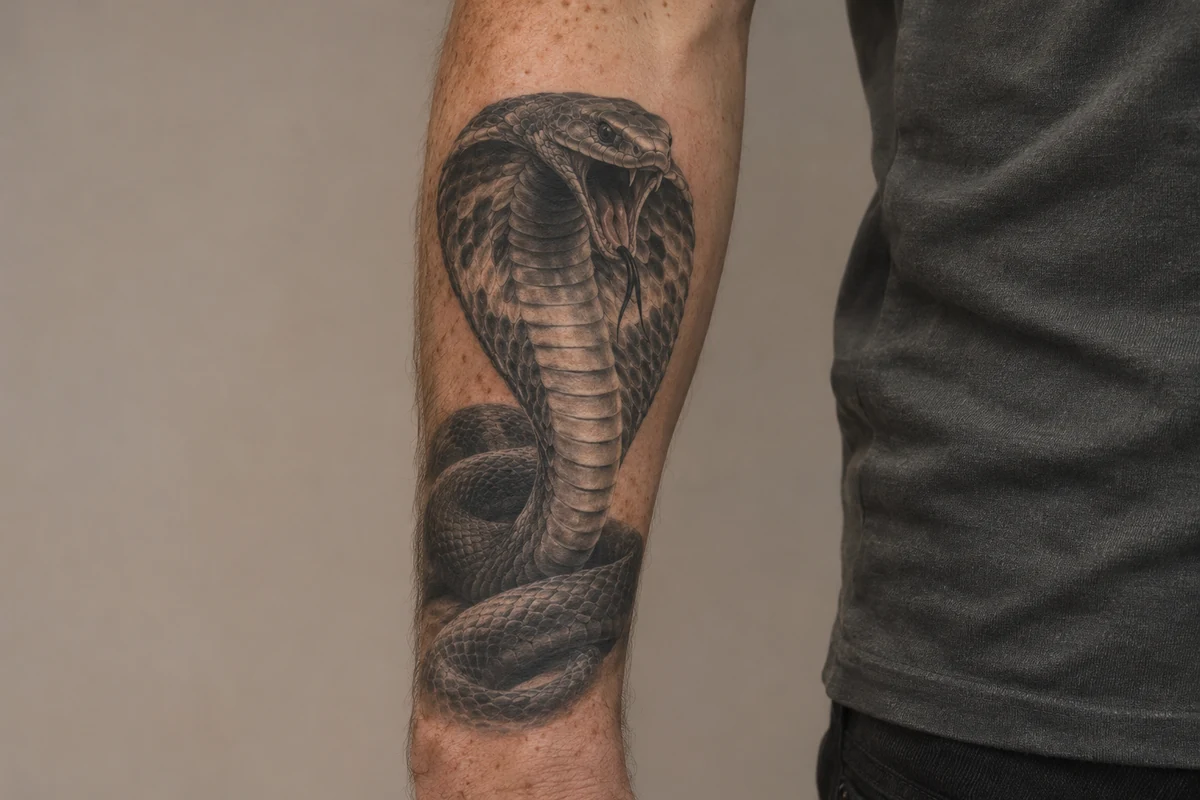
The cobra covers the whole outer forearm. Realism with shading usually means one long session or two shorter ones.
Symbolism: The cobra stands for vigilance, strength and protection. In Asian cultures it guarded temples and rulers.
15. Large snake on the thigh
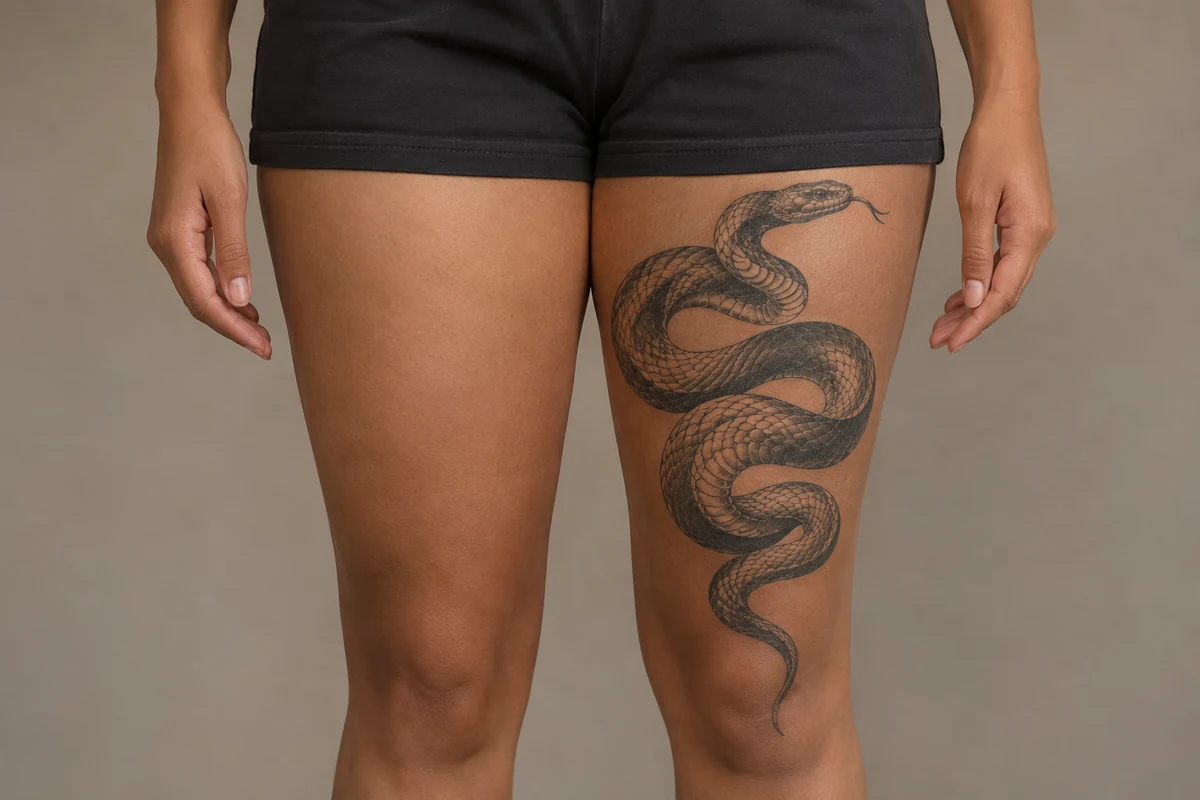
The snake winds from the hip almost to the knee. The thigh is one of the less painful places for a large design.
Symbolism: A large snake on the thigh stands for confidence and femininity that has nothing to prove.
16. Snake on the calf
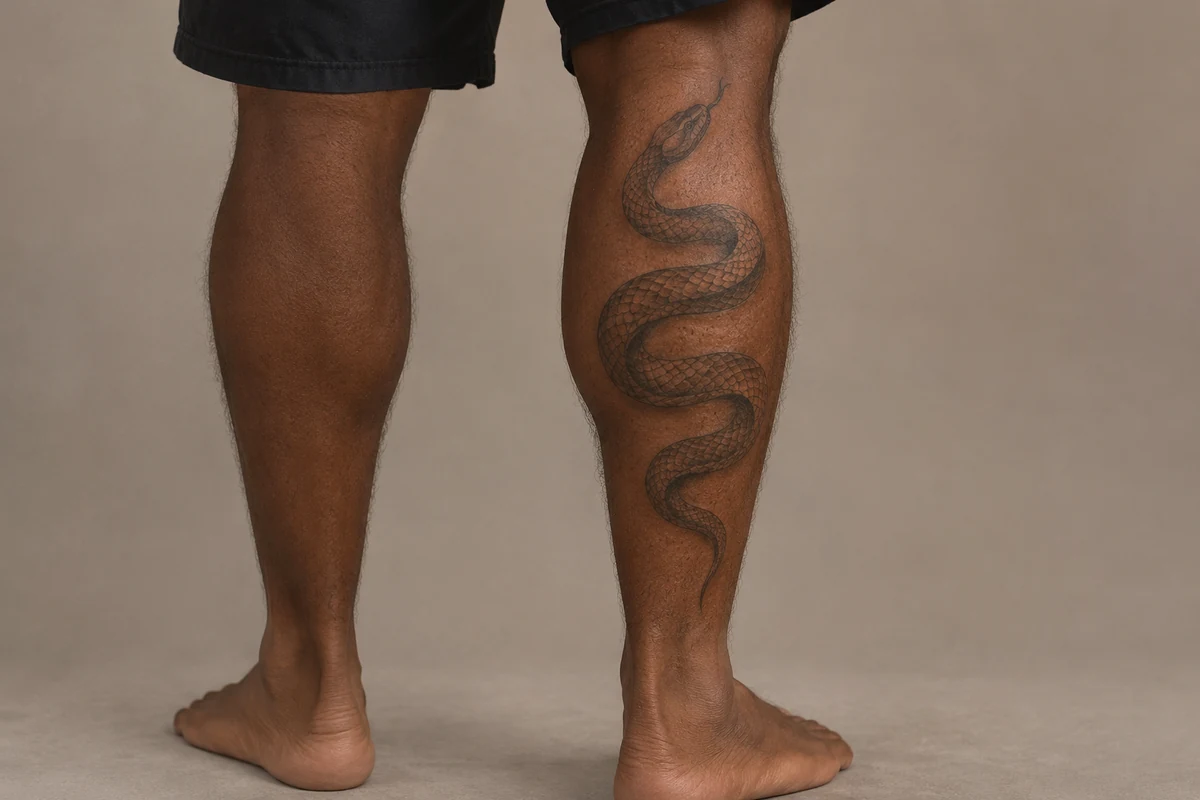
A vertical snake follows the shape of the calf muscle. Calf tattoos heal calmly and rarely get rubbed.
Symbolism: A snake moving up the calf stands for moving forward and the strength to start again.
17. Snake with lilies from hip to thigh
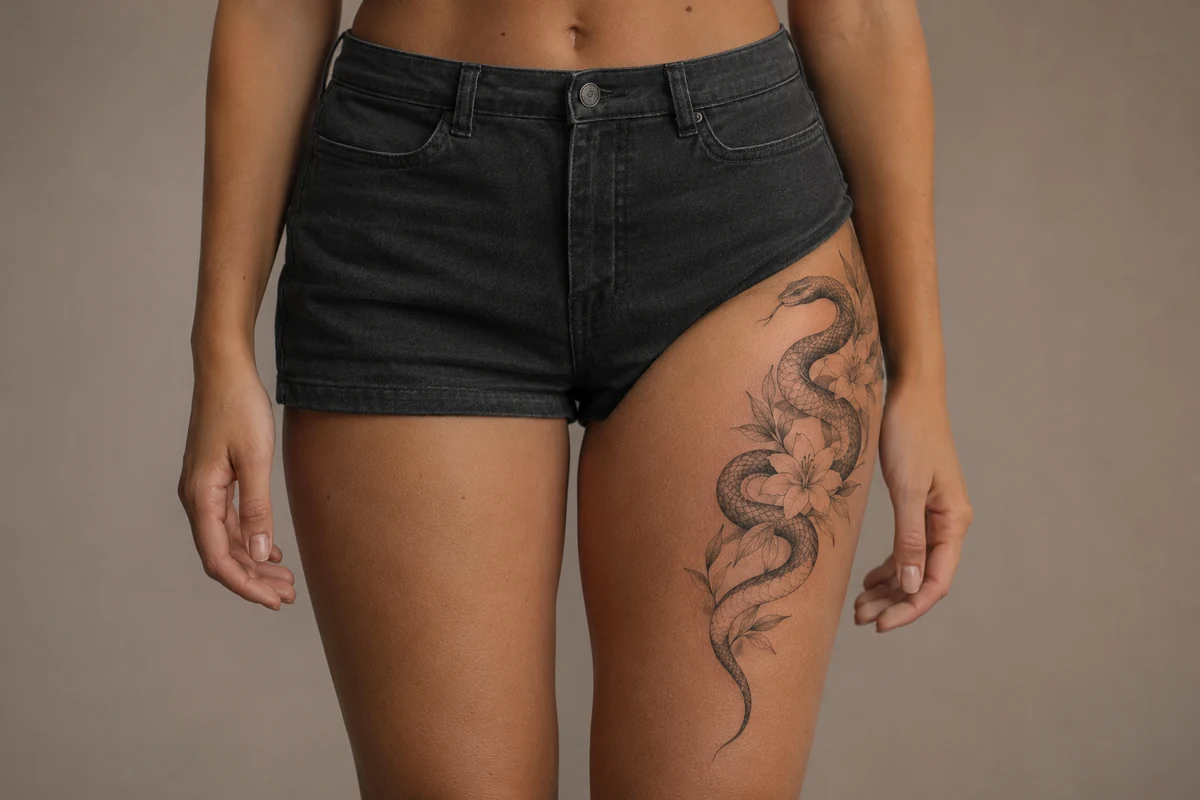
The composition starts on the hip and runs down the thigh. Flowers fill the space between the coils, so the design looks light despite its size.
Symbolism: A snake with lilies combines transformation with purity and rebirth. It is a symbol of a woman starting a new chapter.
18. Snake across the whole upper back
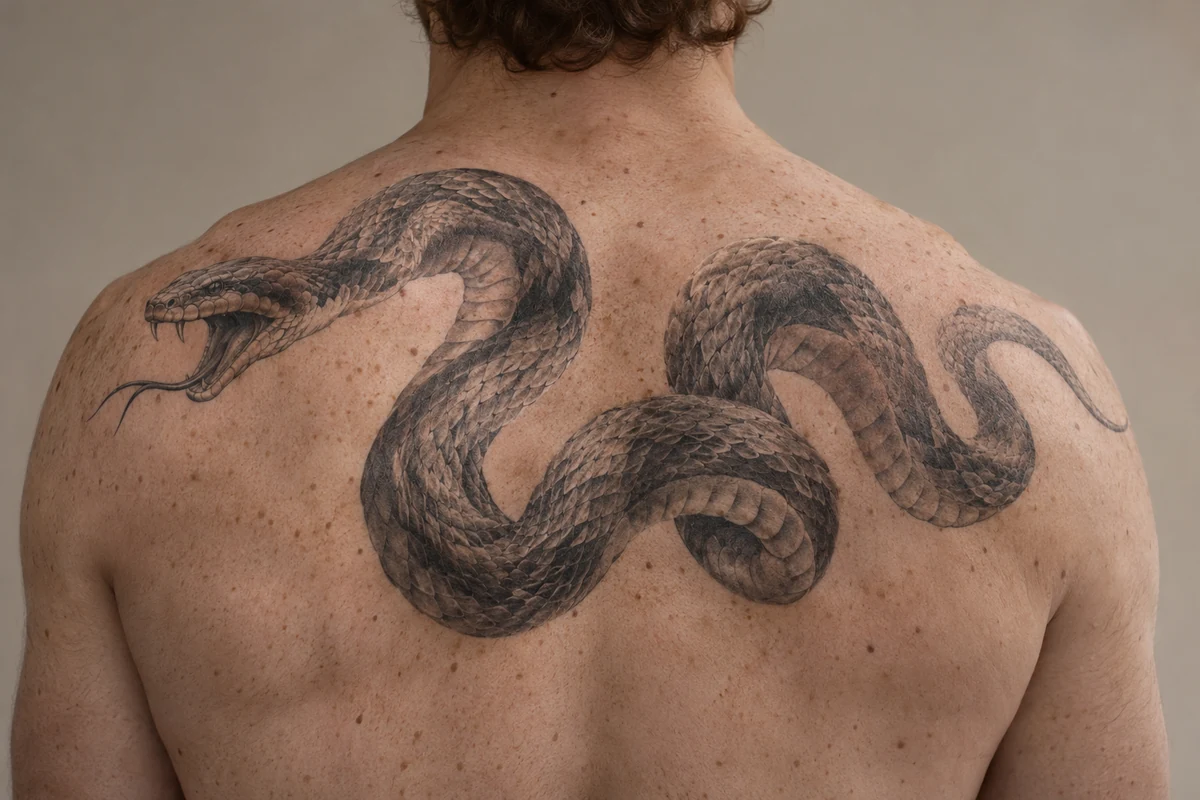
The snake runs from shoulder blade to shoulder blade, with an open mouth near the shoulder. This is a 2–3 session project.
Symbolism: A snake on the back stands for strength and protection. We cannot see our own back, so the snake guards it.
19. Snake with peonies on the upper arm
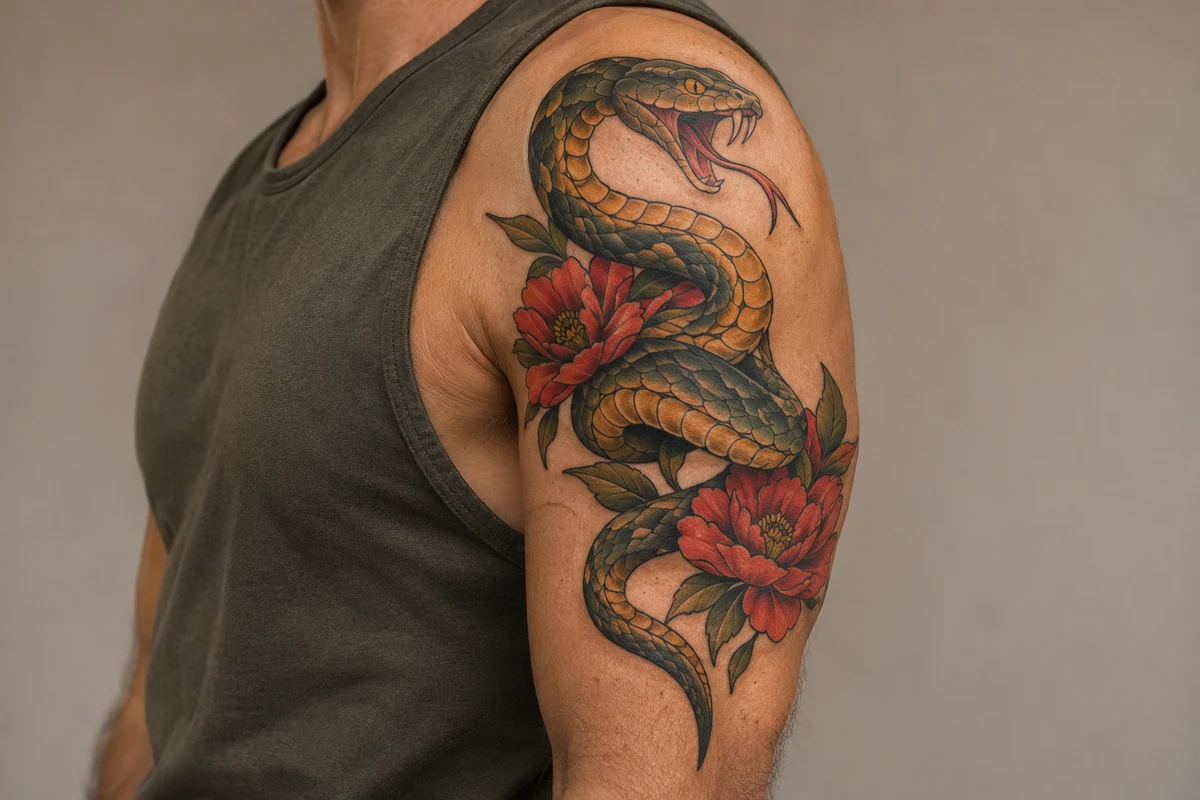
Neo-traditional combines a clear outline with bold color. The snake wraps the upper arm and peonies fill the sides.
Symbolism: A snake with peonies combines danger and beauty. In Japan, the peony means courage and good fortune.
20. Snake on the side of the neck
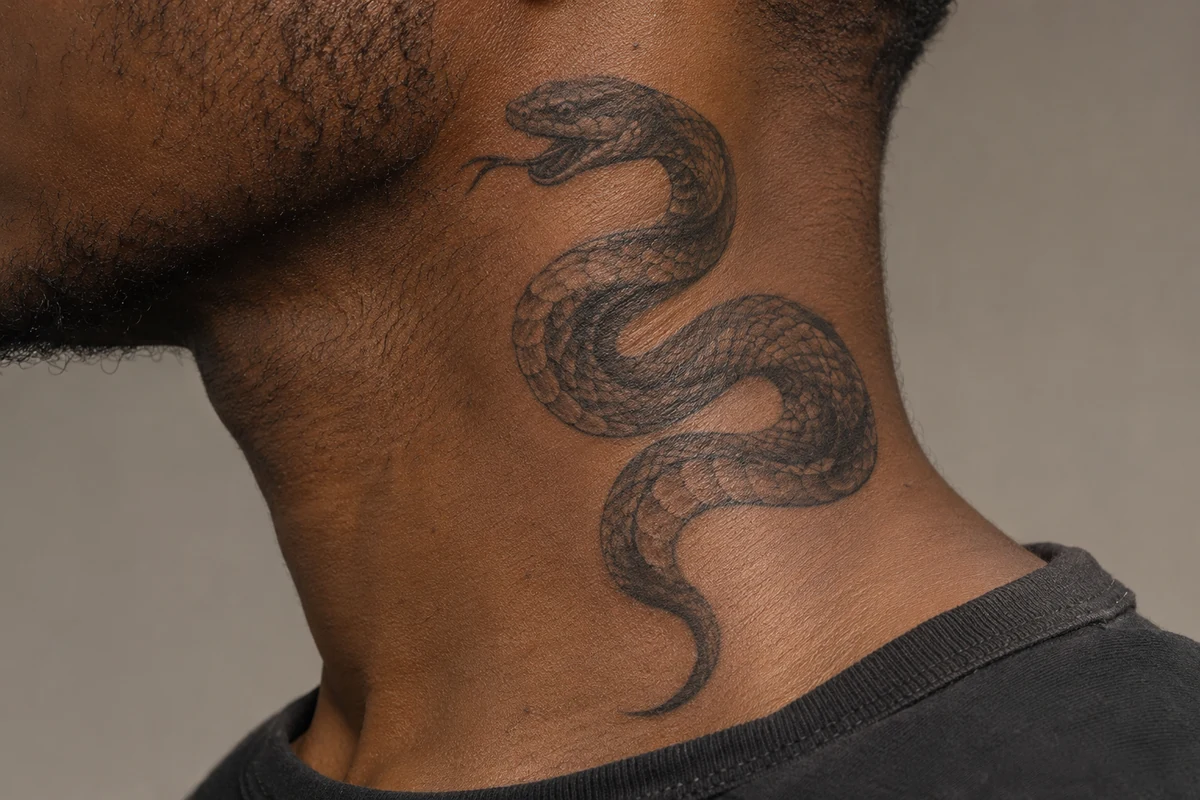
The neck is visible almost all the time. It hurts more than the arm, and the design should be planned so it does not go under the jawline.
Symbolism: A snake on the neck stands for confidence and accepting that others will see your transformation.
21. Realistic snake head
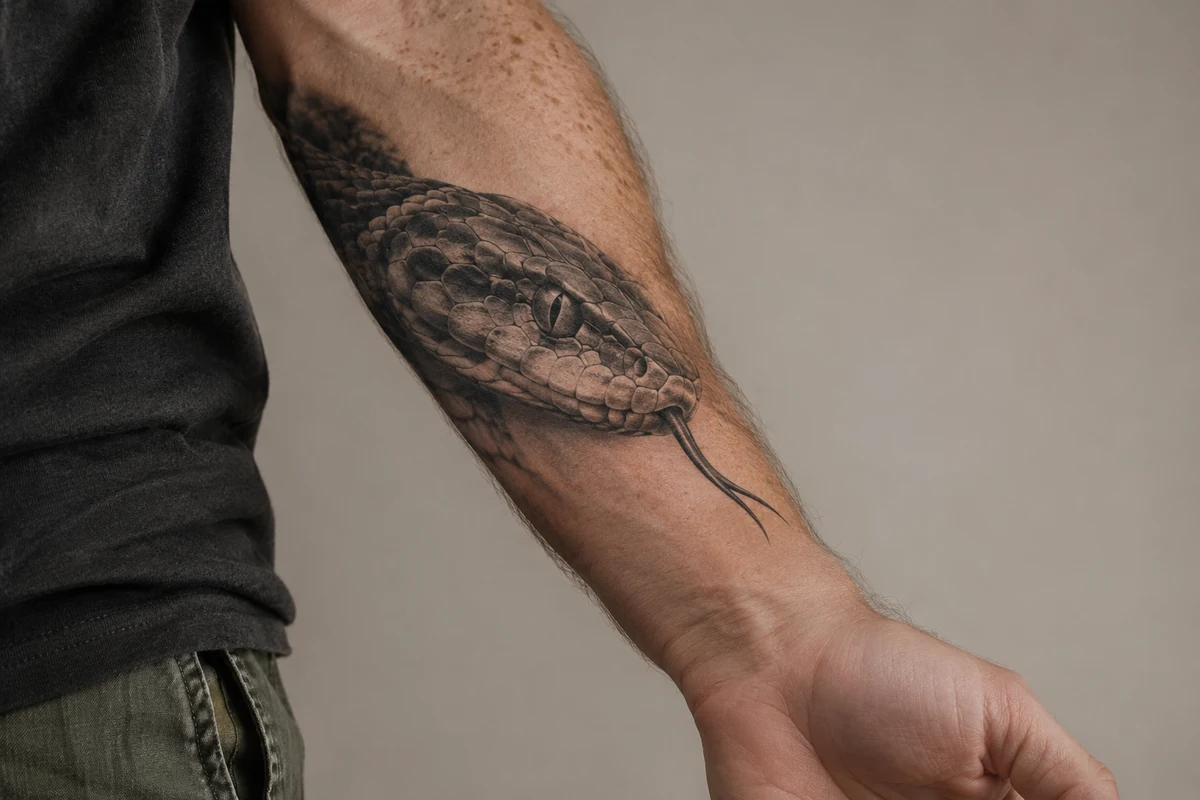
A close-up snake head, as if it were coming out from under the skin. Realism needs a large scale and an experienced artist.
Symbolism: The gaze of a snake stands for vigilance and strength that needs no words.
22. Snake among leaves on the upper arm
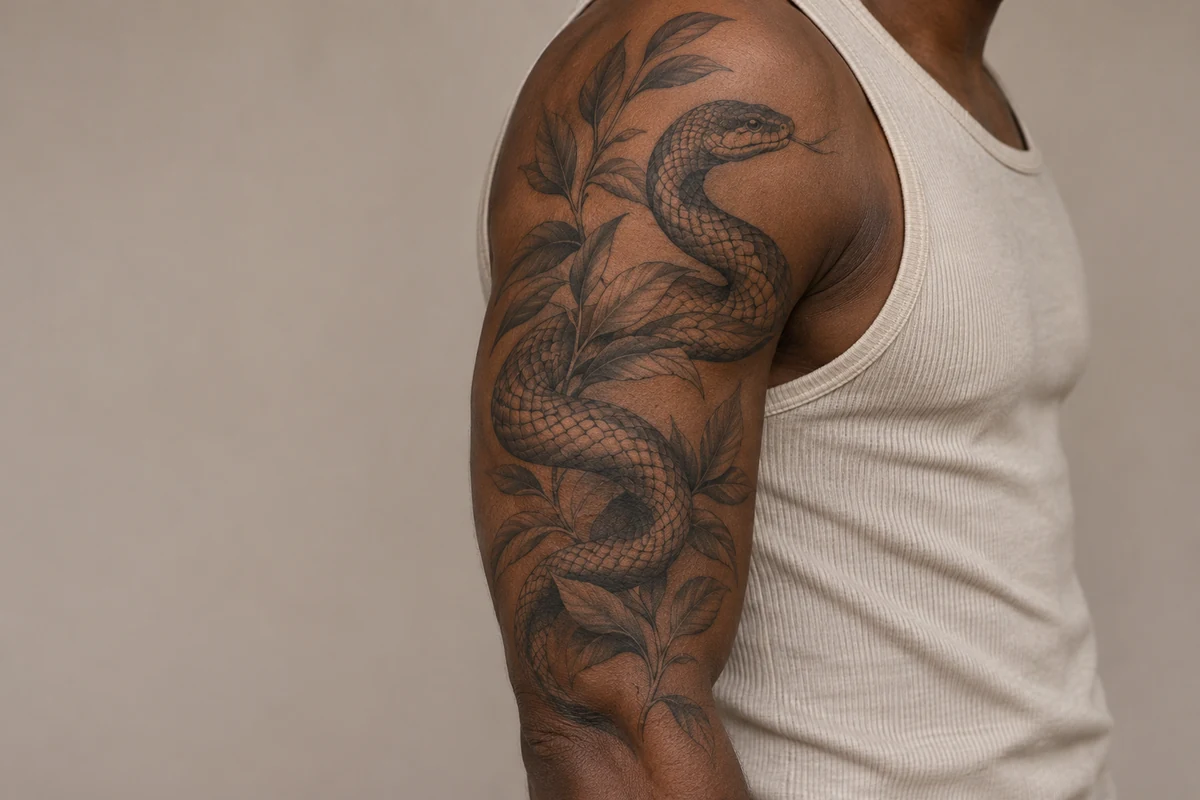
A half sleeve from shoulder to elbow. The leaves fill the space and are easy to connect with the rest of the arm later.
Symbolism: A snake hidden in leaves stands for patience and vigilance. Strength that waits for its moment.
Snake in different styles: 11 designs
23. Snake head on the hand
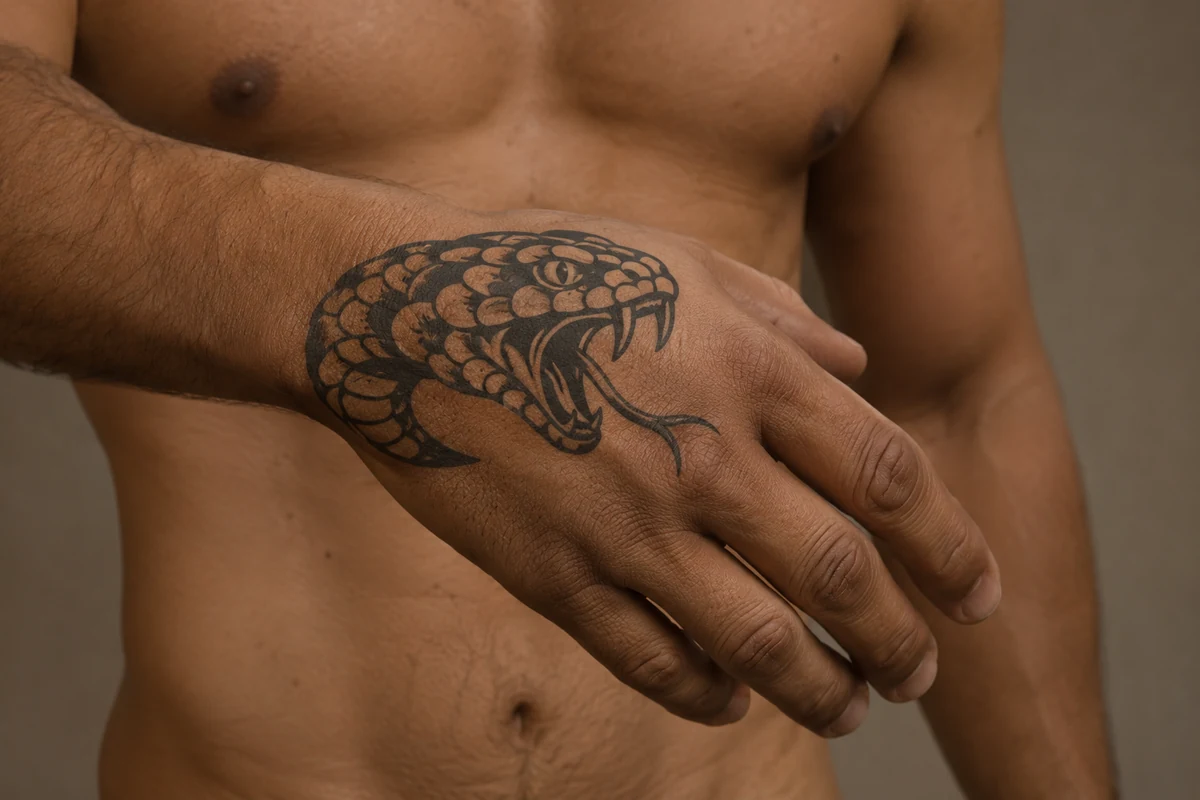
A bold black outline and solid fill hold up well on the hand, where thin lines blur quickly.
Symbolism: A snake head with an open mouth is a warning and a readiness to defend.
24. Old school snake and dagger
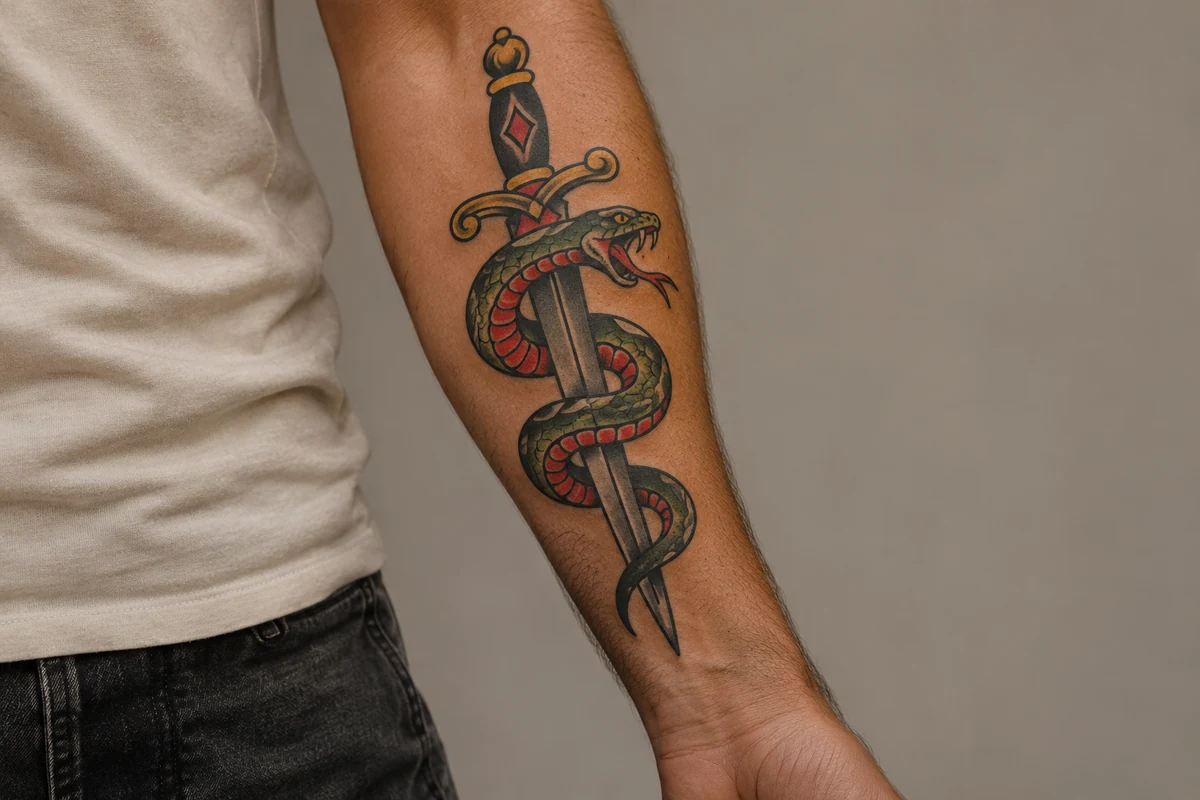
A classic traditional tattoo motif. A thick outline and limited palette keep the design readable for a long time.
Symbolism: A snake on a dagger stands for fighting adversity and strength that overcomes pain.
25. Black snake silhouette
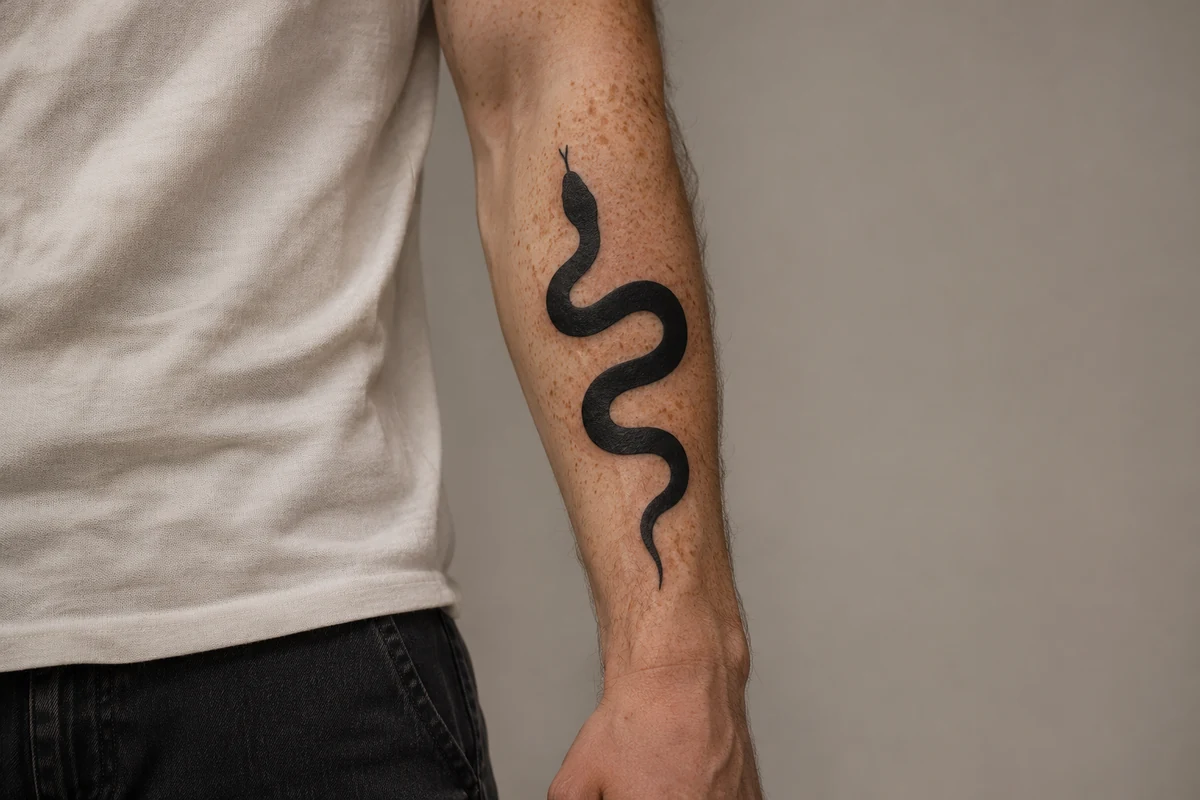
A snake filled with solid black, no scales or details. Simple, bold and very durable.
Symbolism: A black snake stands for mystery, strength and inner power that needs no decoration.
26. Geometric snake
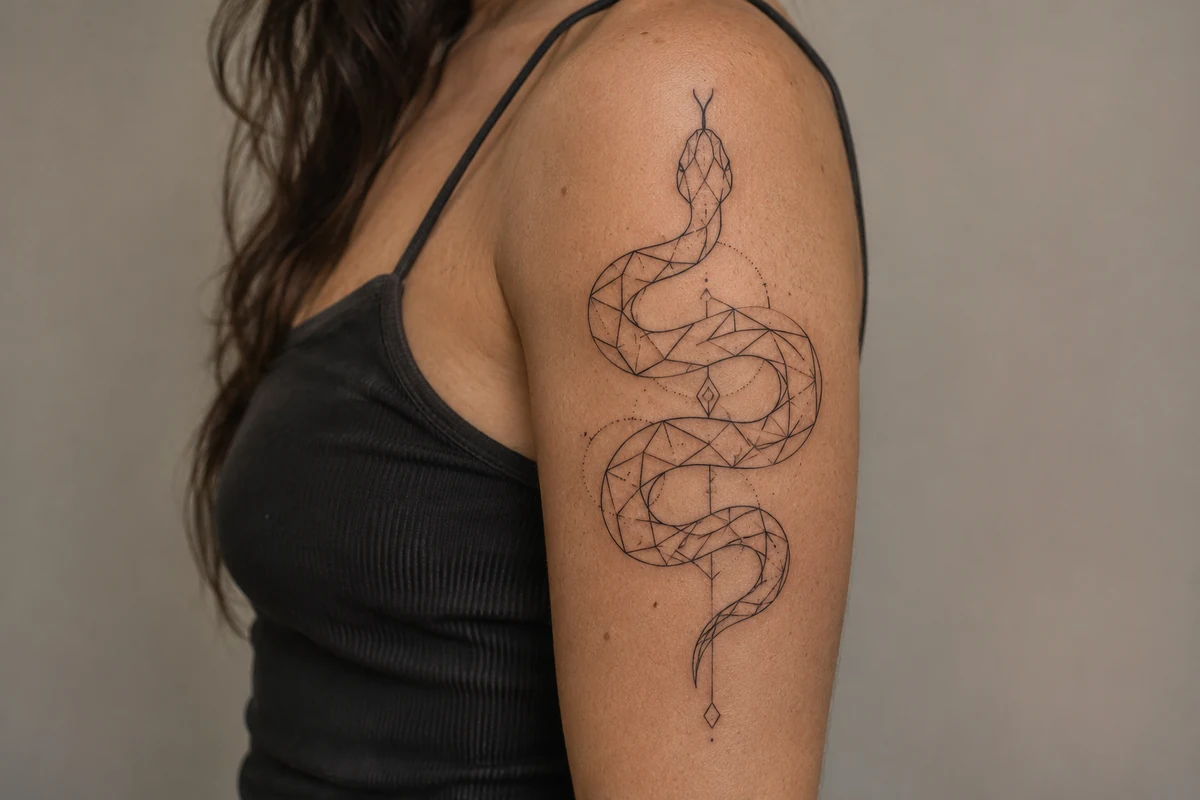
The snake’s body is built from triangles, with dotted circles in the background. Precise linework needs an experienced artist.
Symbolism: A geometric snake combines nature with order. It is a balance between instinct and reason.
27. Watercolor snake on the shoulder blade
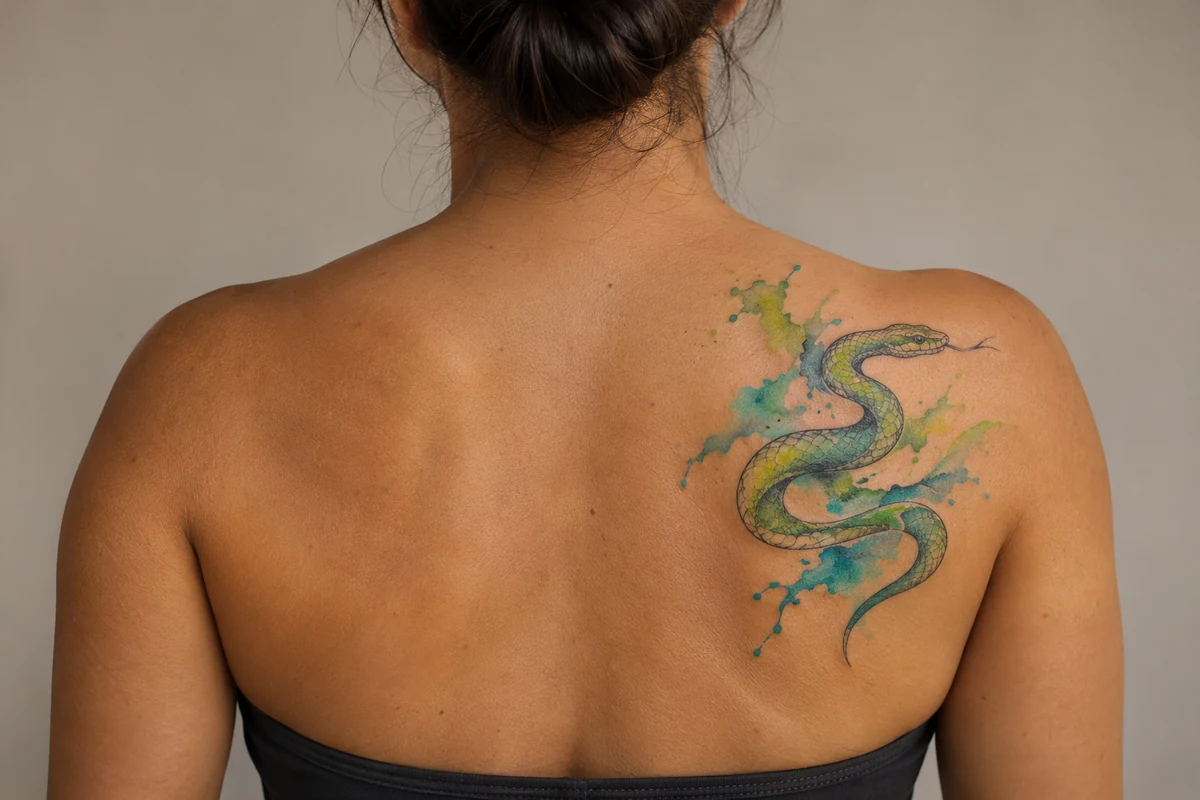
A thin outline holds the shape, and splashes of color add lightness. Watercolor with a clear outline ages better than color alone.
Symbolism: A green watercolor snake stands for rebirth and connection with nature.
28. Red ink snake
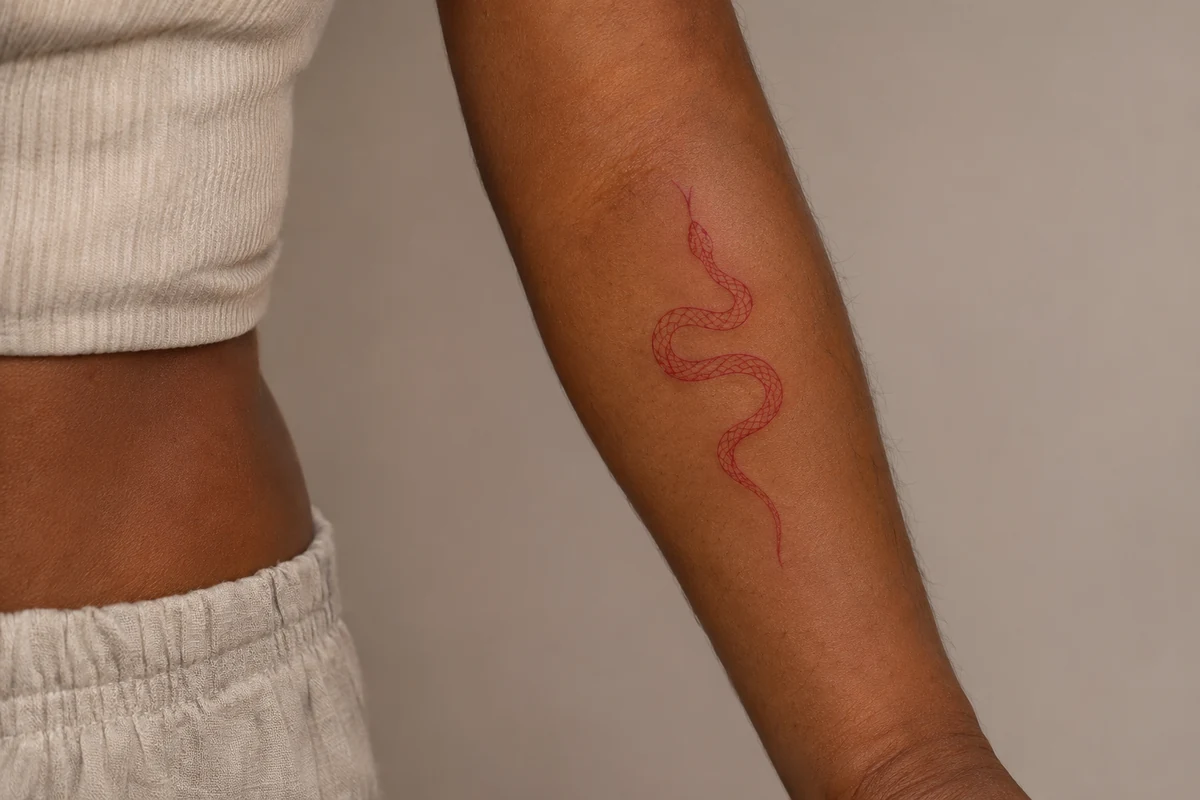
Red ink looks delicate and contrasts well with darker skin. With red, ask your artist about a patch test.
Symbolism: A red snake stands for passion, life energy and courage.
29. White ink snake
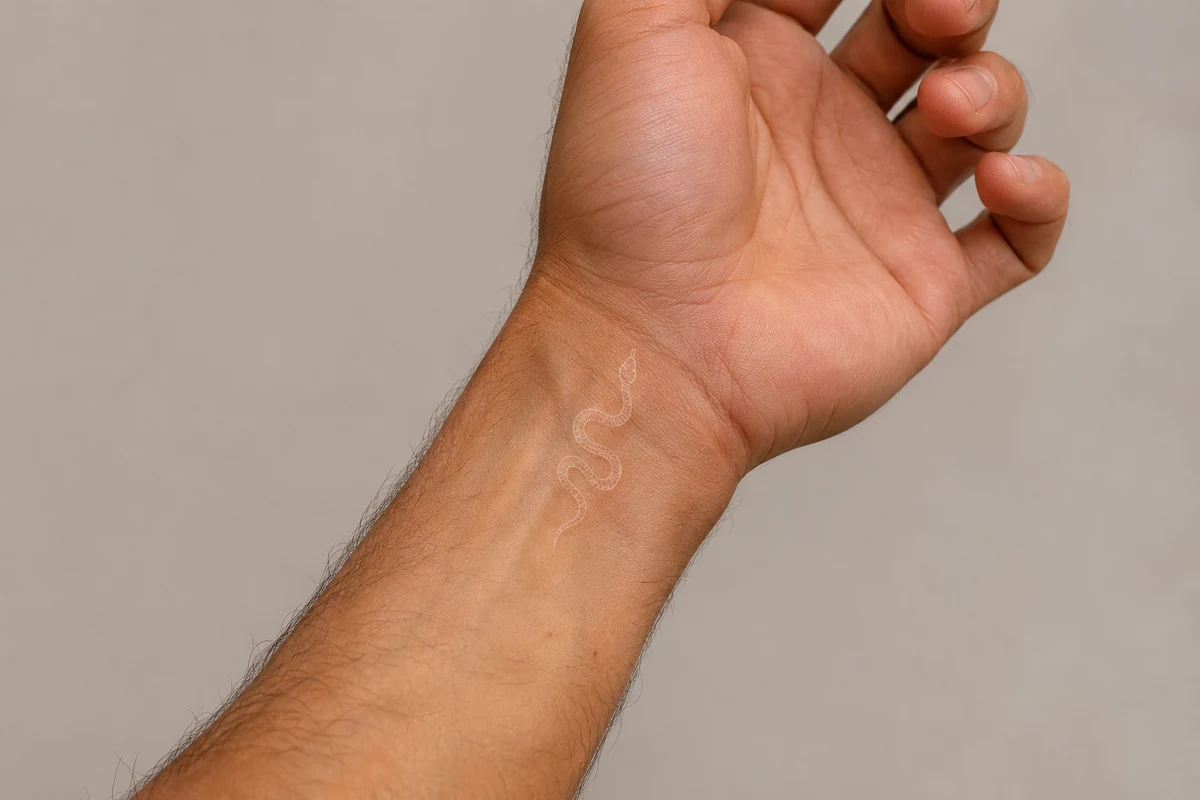
White ink is almost invisible and may turn slightly yellow or fade over time. A good choice for people who want a tattoo just for themselves.
Symbolism: A white snake is a discreet transformation that only you can see.
30. One line snake
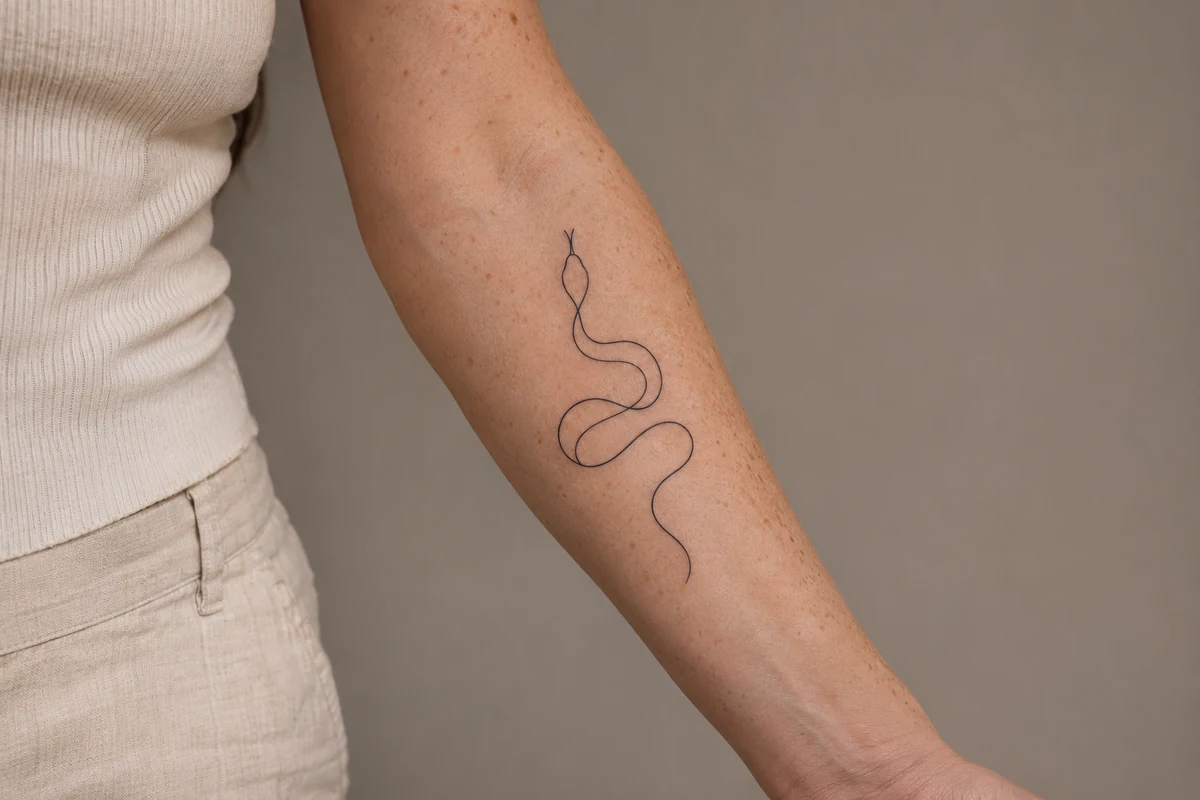
A single unbroken line forms the whole snake. A quick session, but it needs a steady hand.
Symbolism: A continuous line is the path of life. A snake drawn in one move reminds you that everything is connected.
31. Sketch snake with construction lines
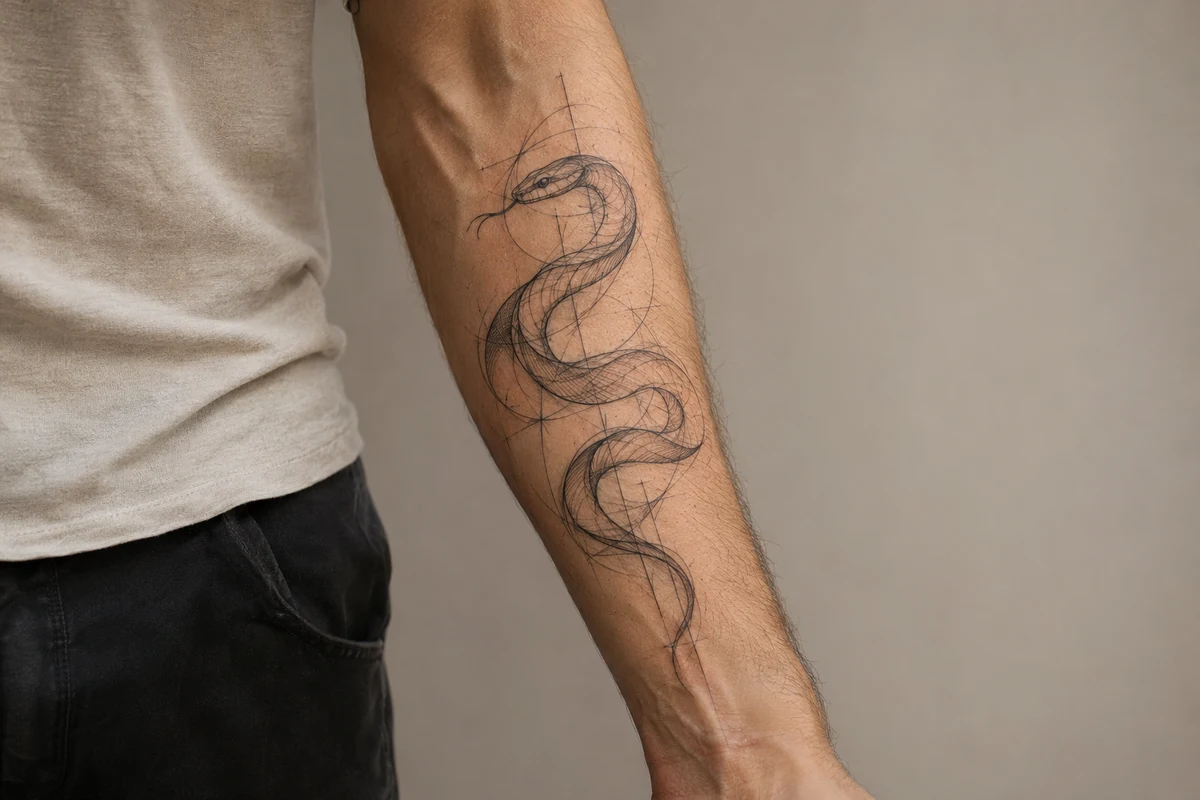
The design looks like a pencil drawing from an artist’s sketchbook. The guide lines are part of the design.
Symbolism: A snake sketch is a process: a transformation that is still going on and does not have to be finished.
32. Tribal snake
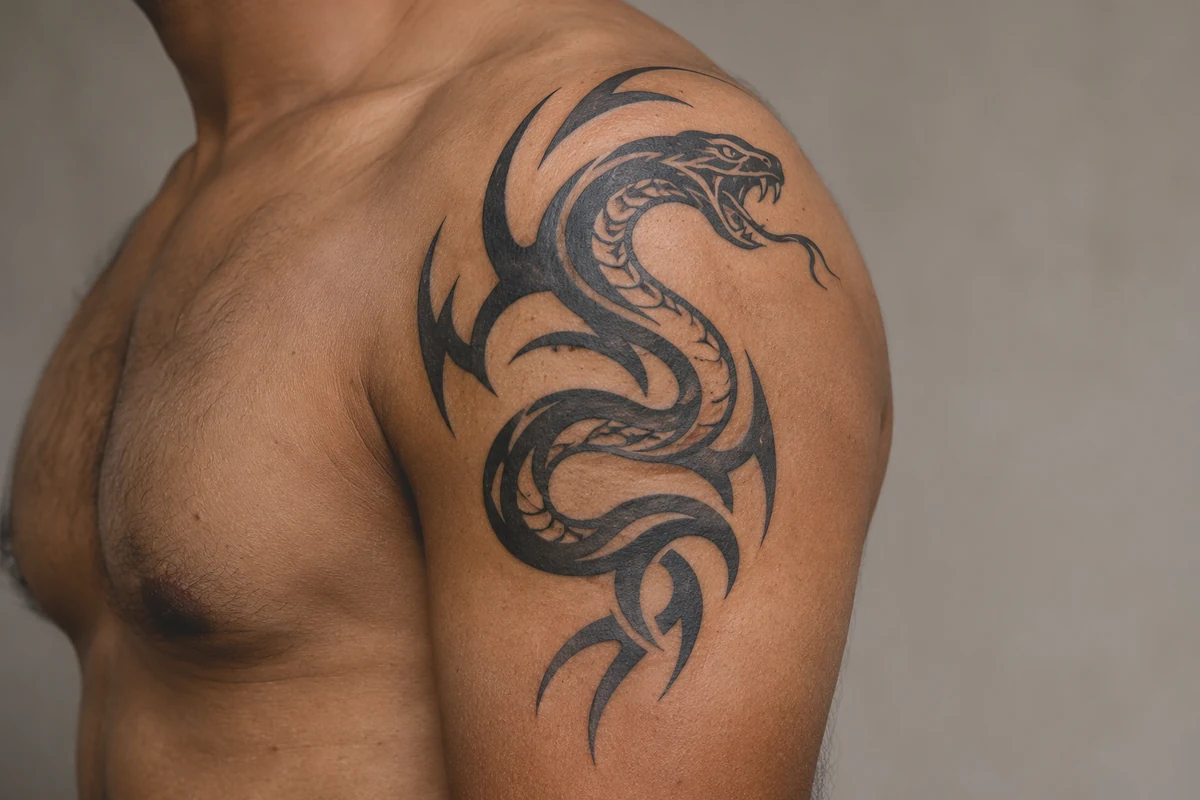
90s tribal is back in a new form. Thick black shapes accentuate the muscles of the upper arm well.
Symbolism: A tribal snake stands for a warrior’s strength and tribal protection.
33. Ignorant style snake
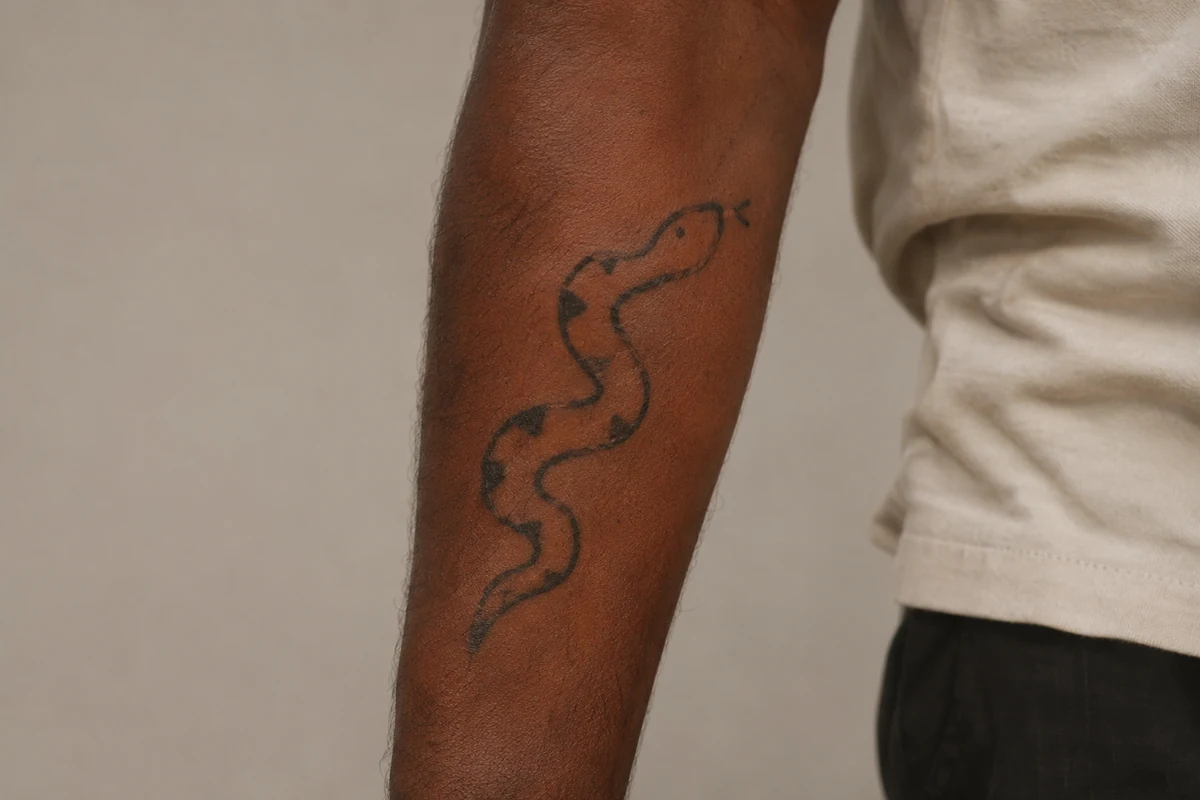
A deliberately imperfect, “childlike” drawing. Ignorant style is quick and has a loose character.
Symbolism: An ignorant style snake stands for not taking yourself, or symbols, too seriously.
Snake with other motifs: rose, skull, moon, lotus: 17 designs
34. Snake wrapped around a rose
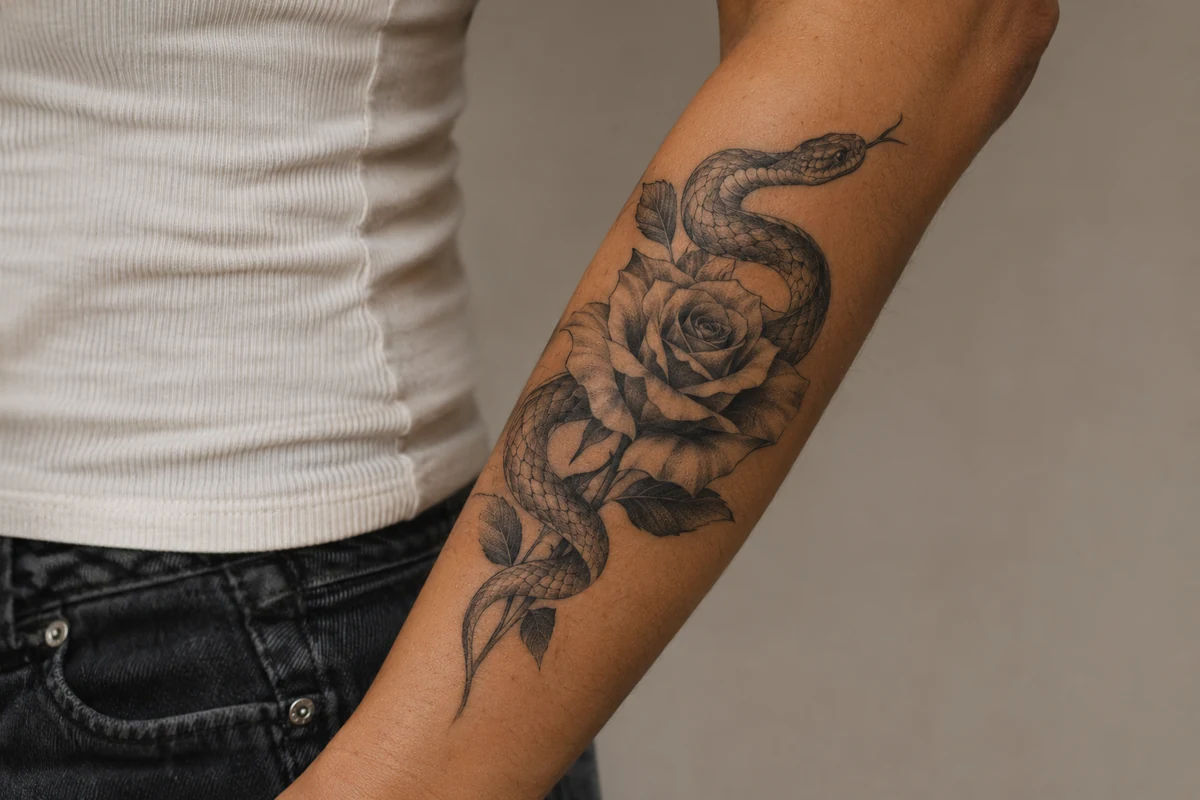
One of the most popular pairings. A rose in the middle and a snake around it create a vertical composition for the whole forearm.
Symbolism: A snake with a rose is beauty and danger in one. Love that can defend itself.
35. Snake and skull
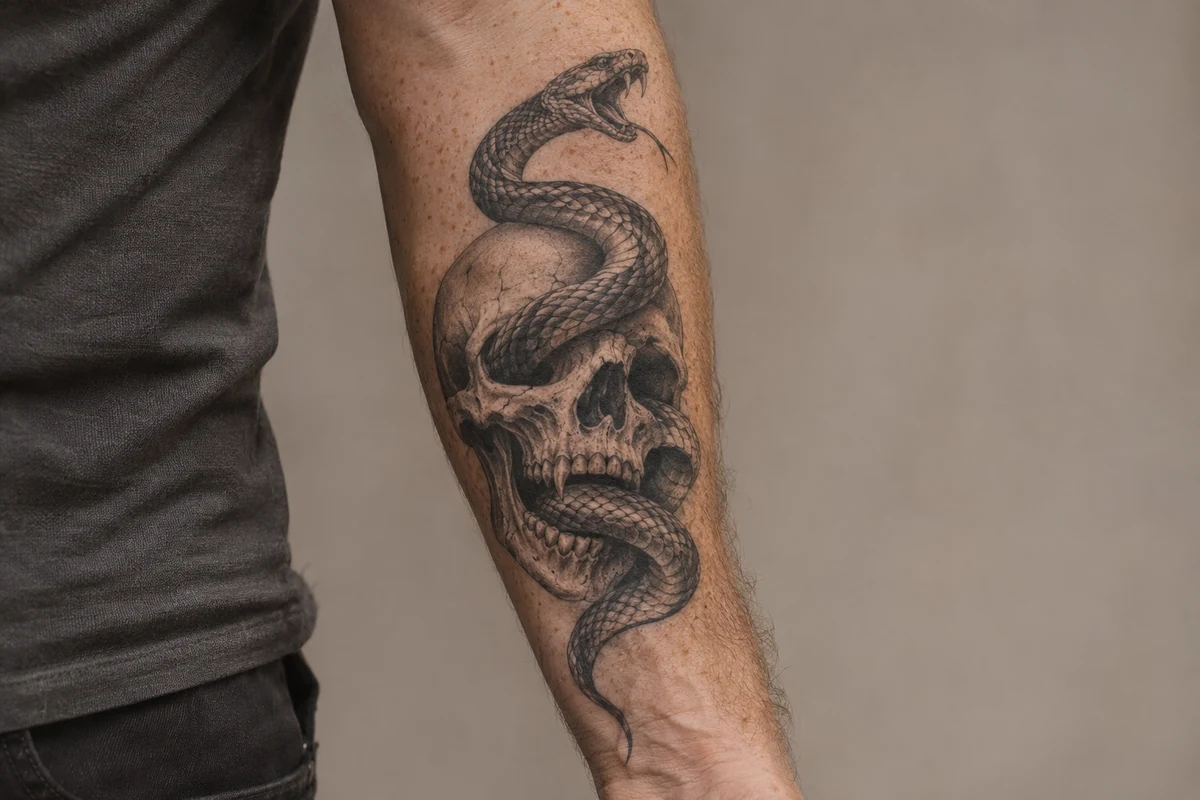
The snake comes out of an eye socket and wraps around the skull. Realism needs a large size for the details of bone and scales to stay readable.
Symbolism: A snake and skull stand for life, death and rebirth. A reminder that every end brings a new beginning.
36. Fine line snake and dagger
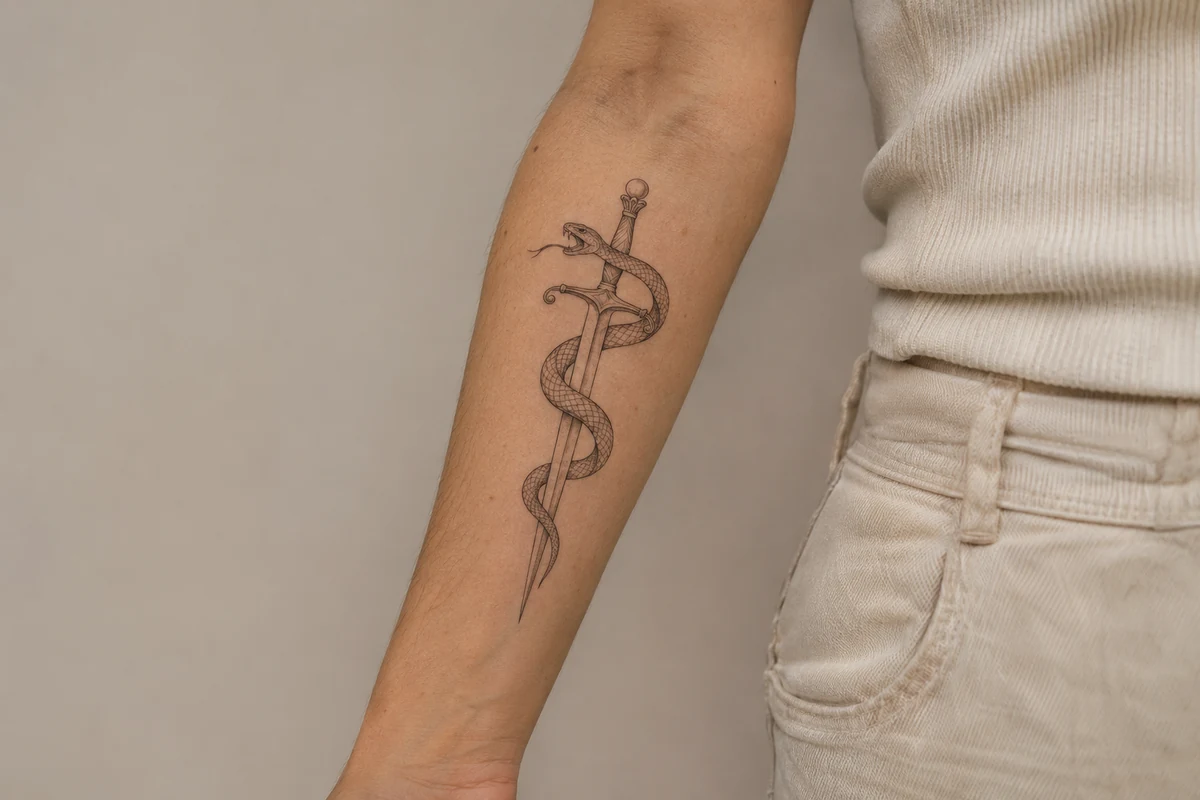
The same classic motif as in old school, but in fine line and without color. Lighter and more feminine.
Symbolism: A snake on a dagger stands for courage and readiness to defend yourself.
37. Snake and crescent moon
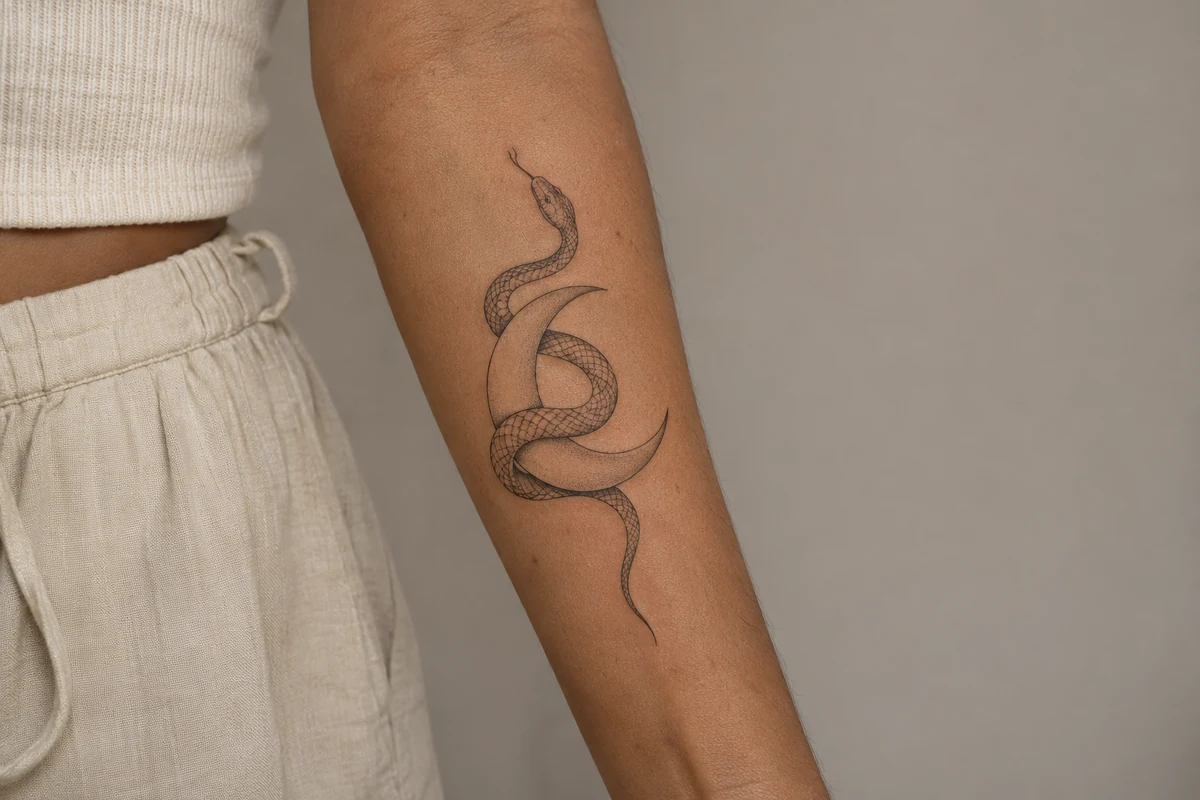
The moon in the middle and the snake around it create a compact vertical composition of 10–12 cm.
Symbolism: A snake with the moon stands for feminine intuition, cycles and the transformation that comes with every new phase.
38. Snake with an apple on the upper arm
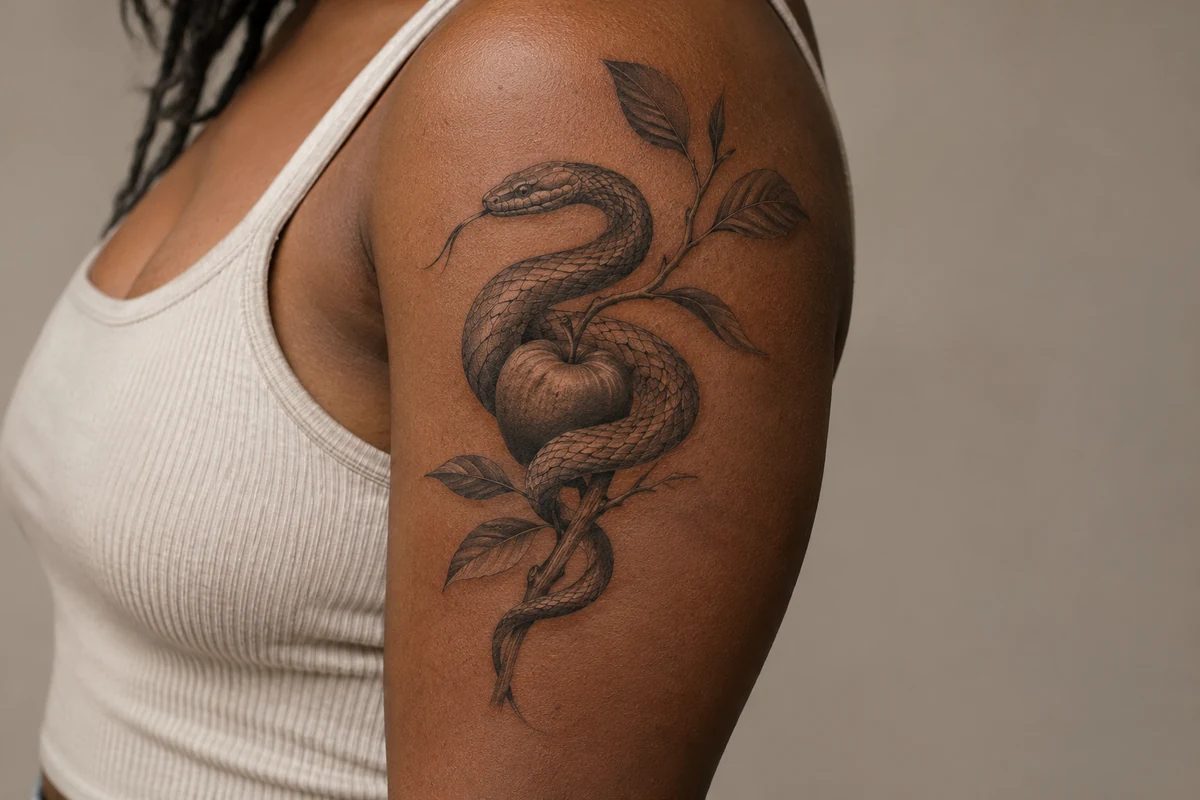
A biblical motif in realistic shading. A branch with leaves gives the composition a vertical line.
Symbolism: A snake with an apple stands for temptation, knowledge and free choice. For many women it is a symbol of the courage to follow their own path.
39. Ouroboros on the forearm
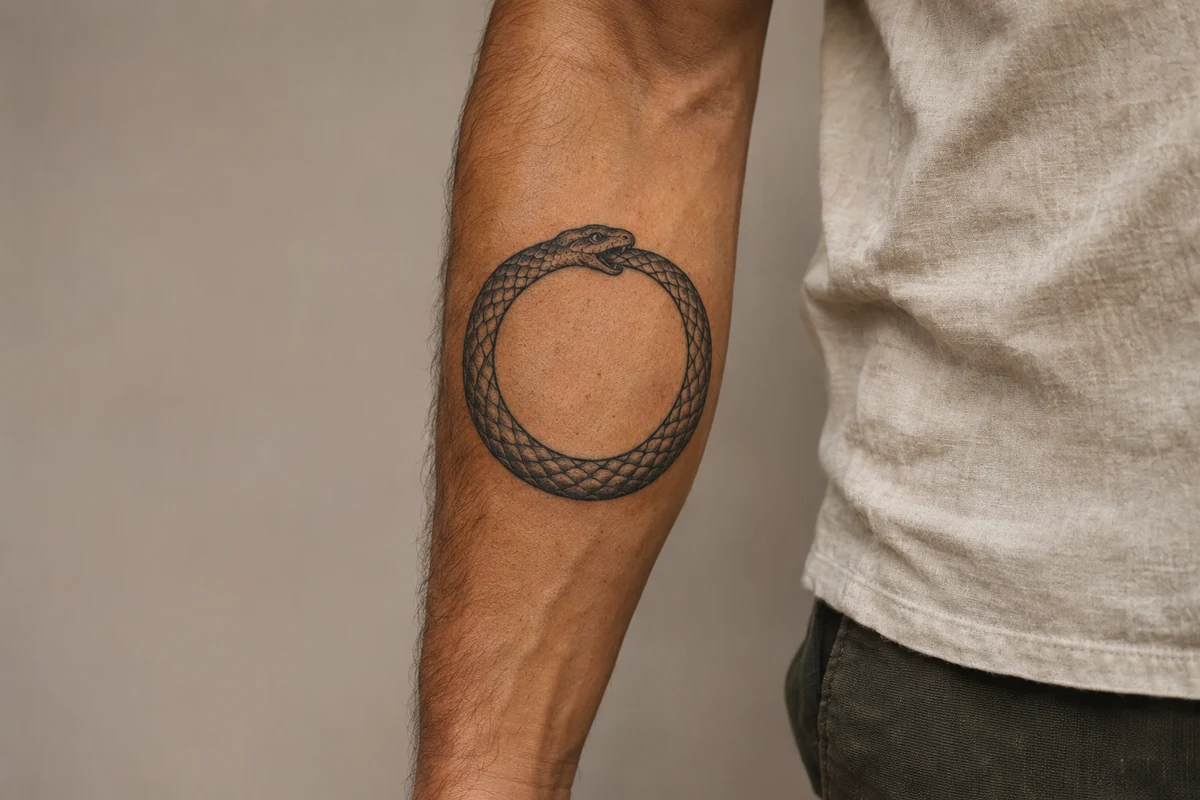
A circle formed by a snake is a clear symbol for any arm. A precise circle needs an experienced artist.
Symbolism: The ouroboros stands for infinity, the cycle of life and death, and eternal return.
40. Snake and lotus on the back
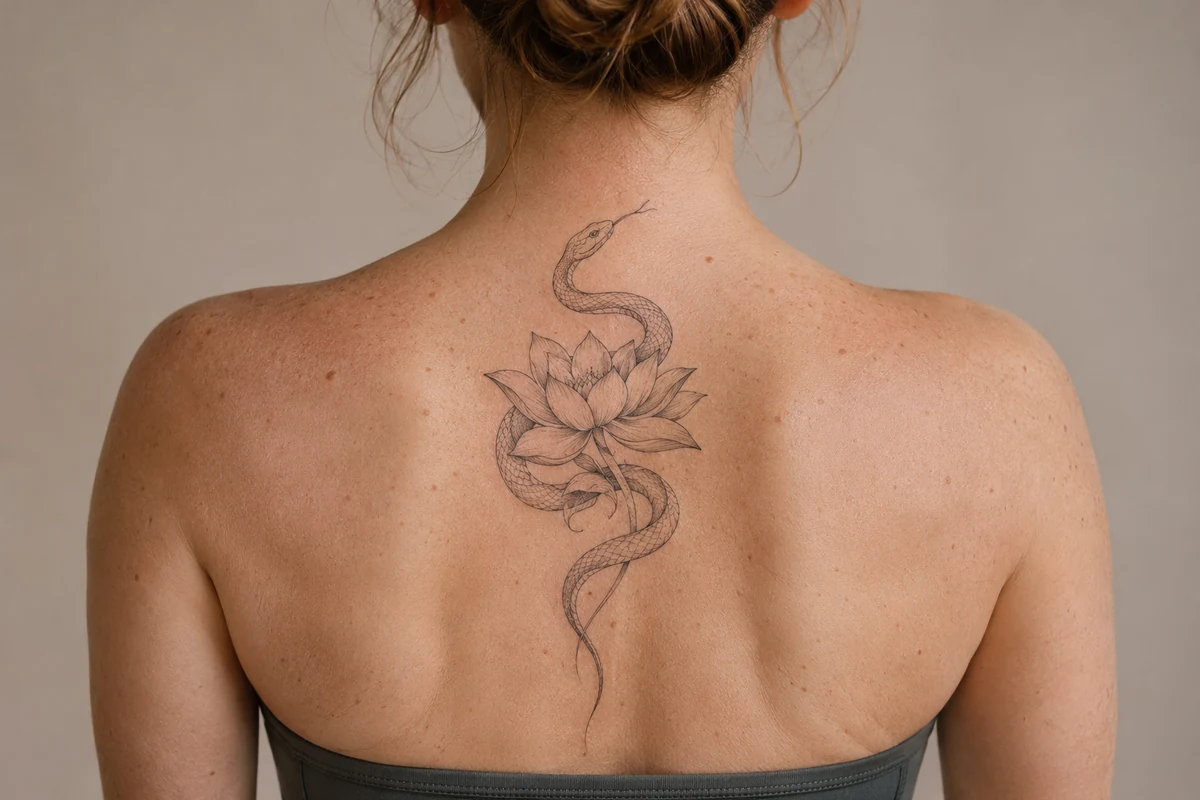
A vertical composition between the shoulder blades. The lotus sits in the middle, and the snake leads the eye up and down.
Symbolism: The lotus grows out of mud and the snake sheds its skin. Together they stand for purification and spiritual growth.
41. Snake and eye
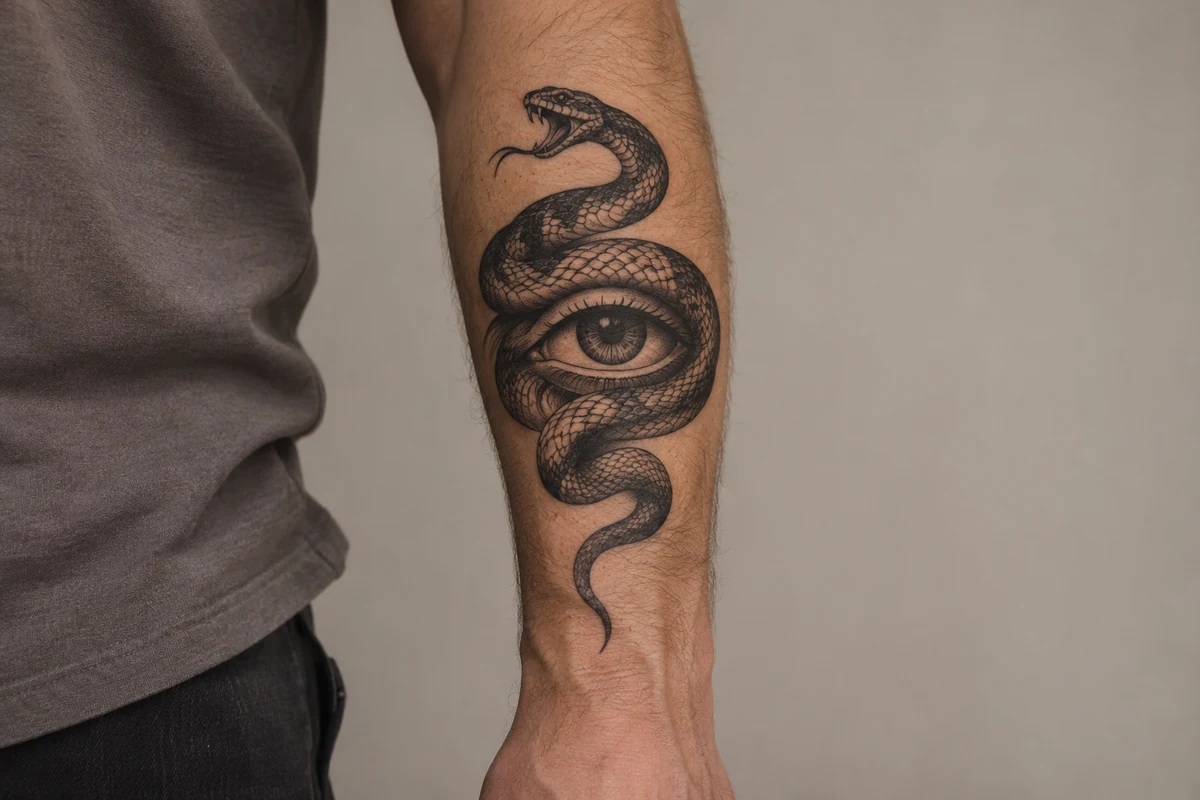
The eye in the middle draws attention, and the snake leads it across the whole forearm.
Symbolism: A snake with an eye stands for vigilance, intuition and protection against evil.
42. Snake and butterflies
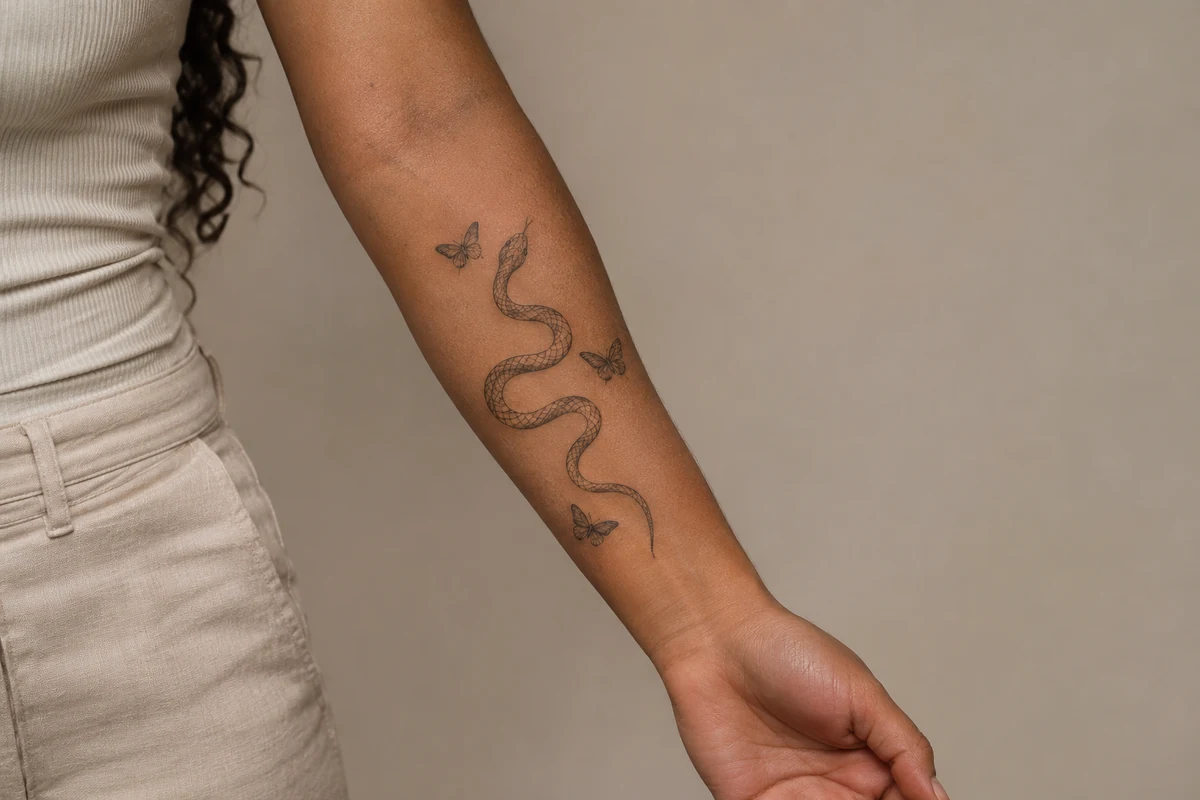
A slender snake and small butterflies create a light composition that is easy to extend with more elements.
Symbolism: A snake and a butterfly are two transformations: one by shedding skin, the other by leaving the cocoon.
43. Snake with a fern on the ribs
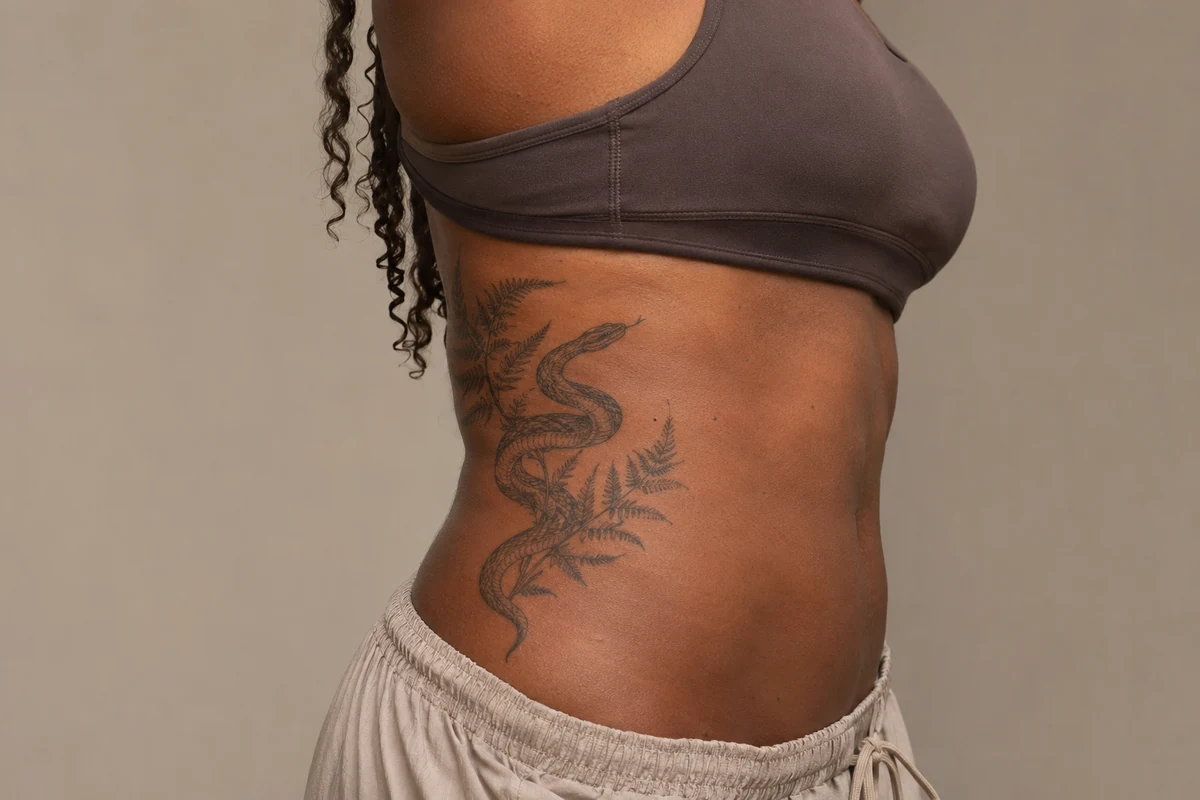
The fern and snake run vertically along the side. Ribs hurt more, but fine line shortens the session.
Symbolism: A fern stands for new life and perseverance. With a snake it becomes a symbol of quiet, natural strength.
44. Two intertwined snakes on the back
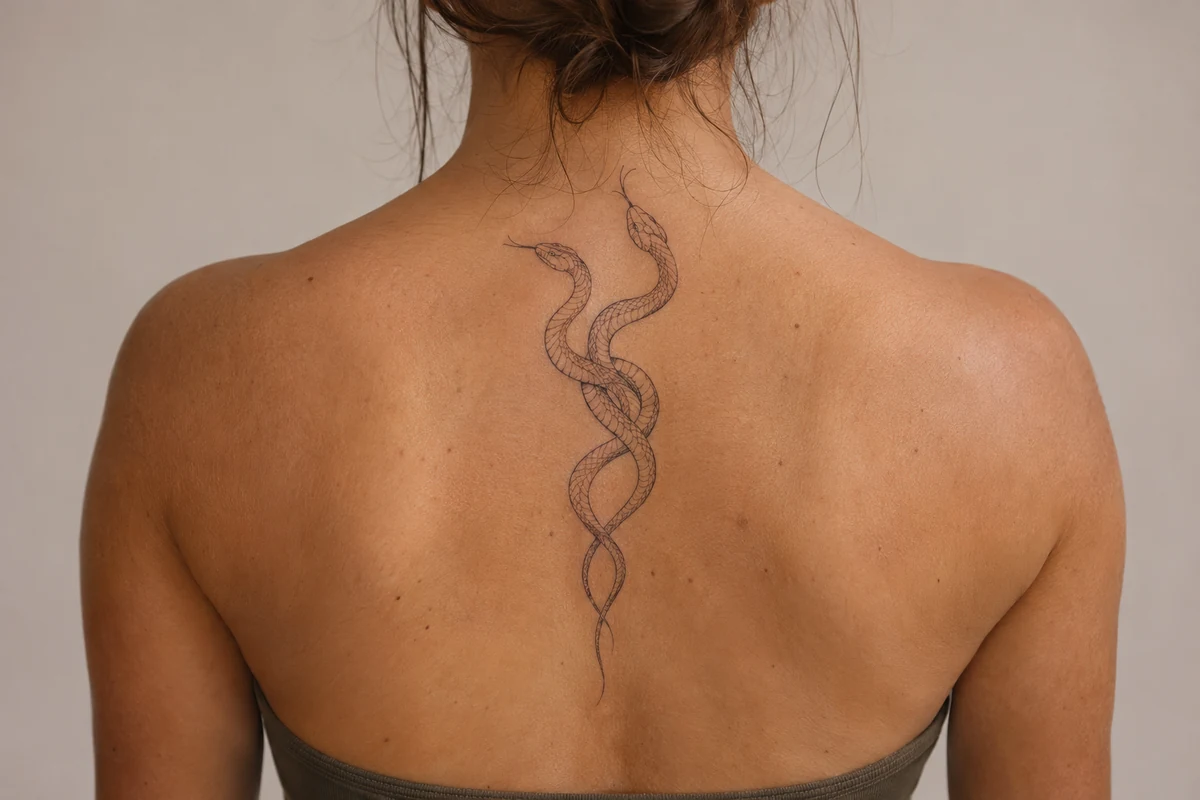
Two snakes rise along the spine and twist around each other. The slim composition suits the line of the back.
Symbolism: Two intertwined snakes stand for the balance of opposites and the bond of two forces.
45. Winged caduceus
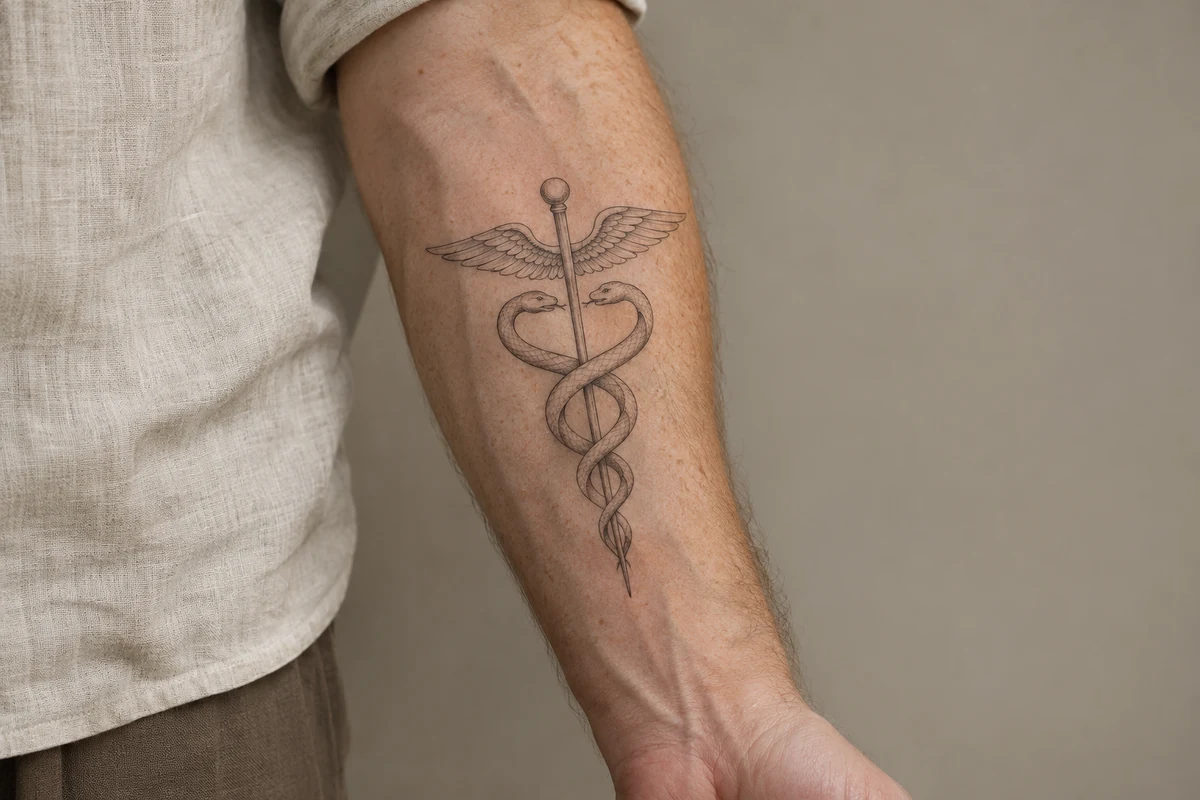
The caduceus is the staff of Hermes. It is often confused with the rod of Asclepius, which has a single snake and is the symbol of medicine.
Symbolism: The caduceus stands for balance, communication and protection on the road. For many it is also a symbol of trade and travel.
46. Snake with a mandala on the shoulder blade
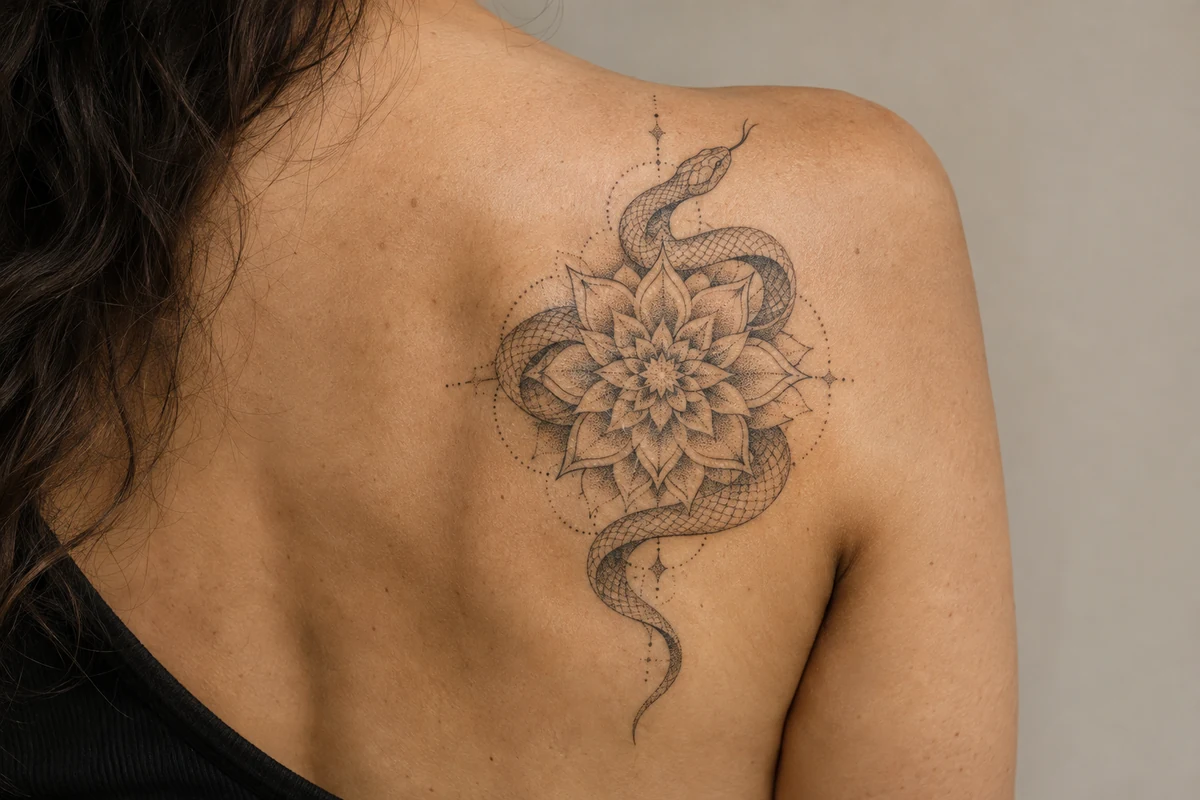
A dotwork mandala and a fine line snake. Dotwork gives soft shading that ages well.
Symbolism: A mandala stands for harmony and wholeness, and the snake brings transformation into it.
47. Old school snake and panther
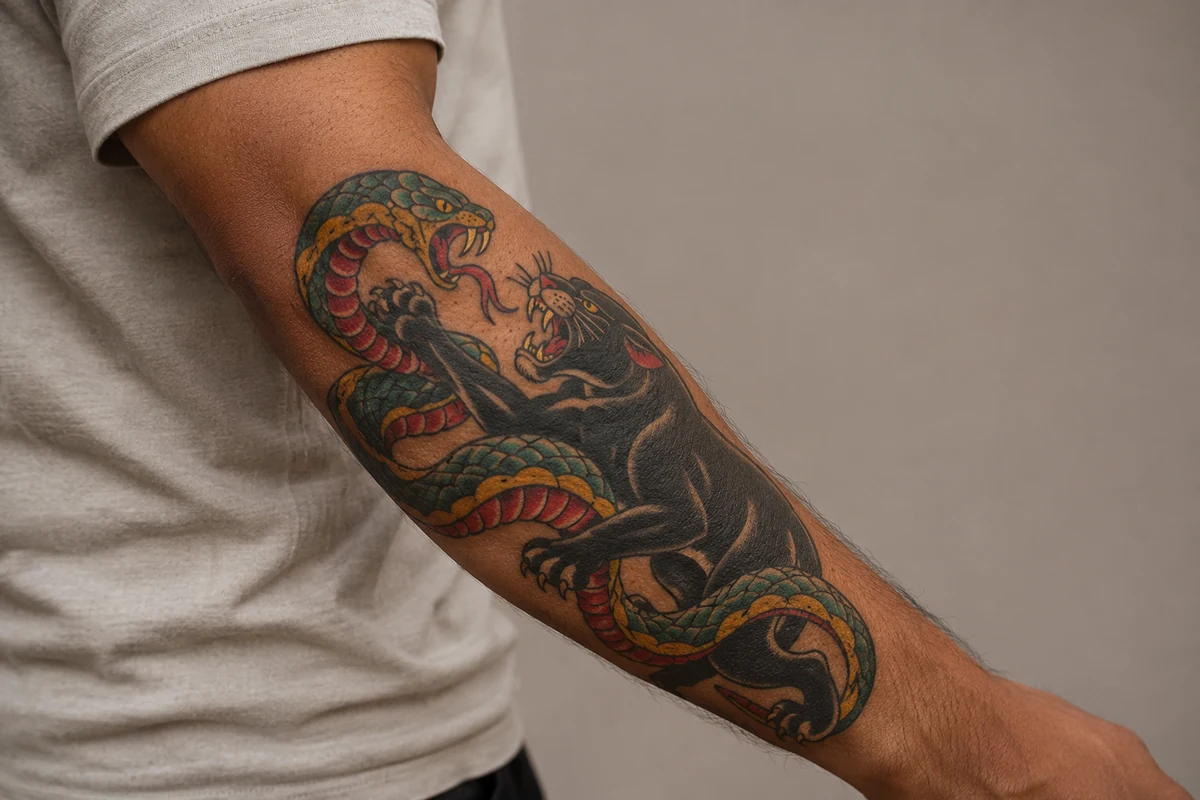
A classic fight scene from traditional sailor tattoos. It covers the whole forearm from elbow to wrist.
Symbolism: A snake fighting a panther is a struggle of two forces: cunning and courage.
48. Japanese snake with peonies on the upper arm
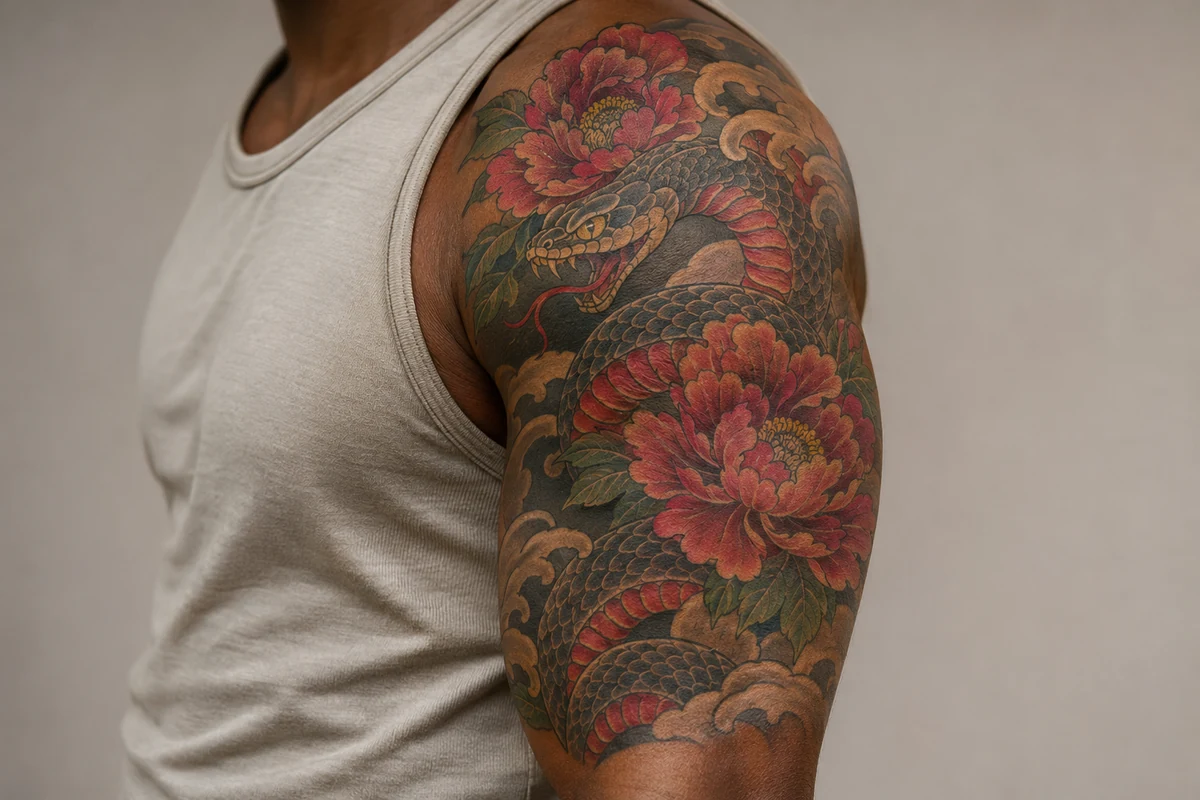
A classic irezumi half sleeve. The snake, peonies and a cloud background fill the upper arm down to the elbow.
Symbolism: In Japan the snake protects against illness and misfortune, and the peony means courage and wealth.
49. Snake with chrysanthemums on the thigh
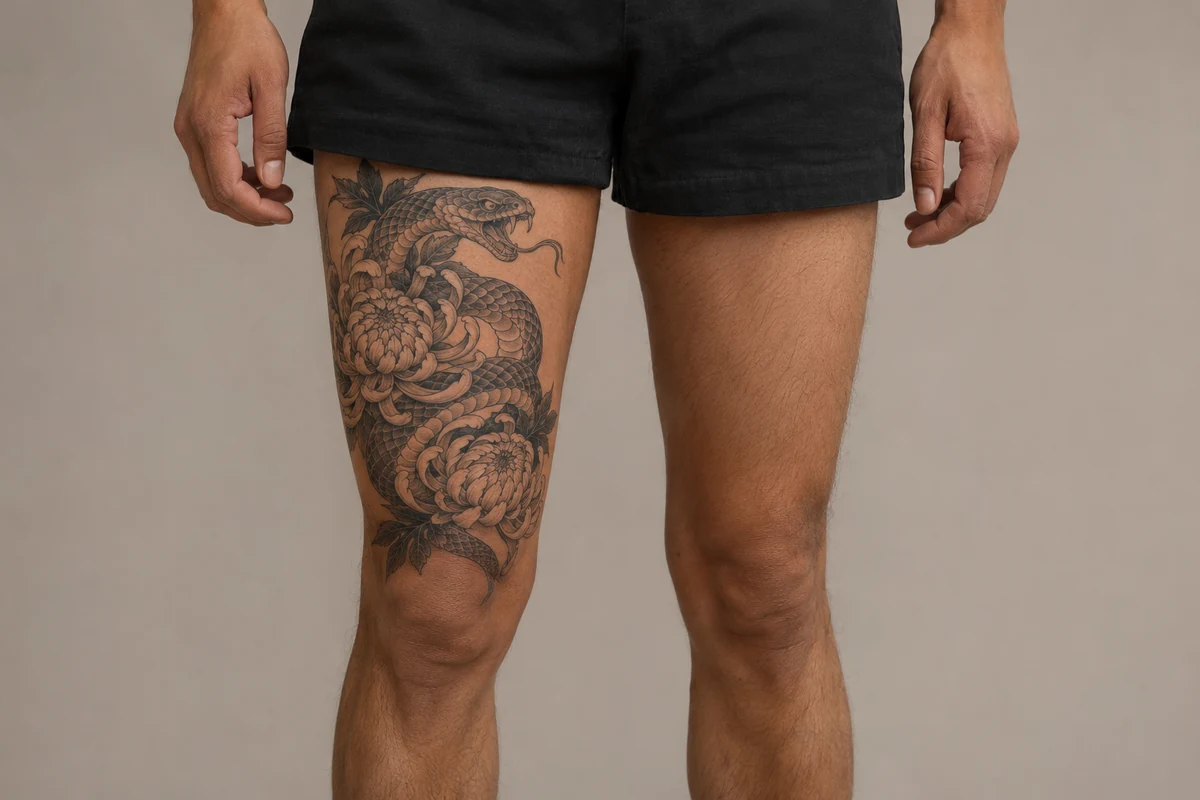
A Japanese motif without color. Chrysanthemums fill the space between the coils.
Symbolism: In Japan the chrysanthemum stands for long life and nobility, and the snake for protection.
50. Snake with an ornament along the spine
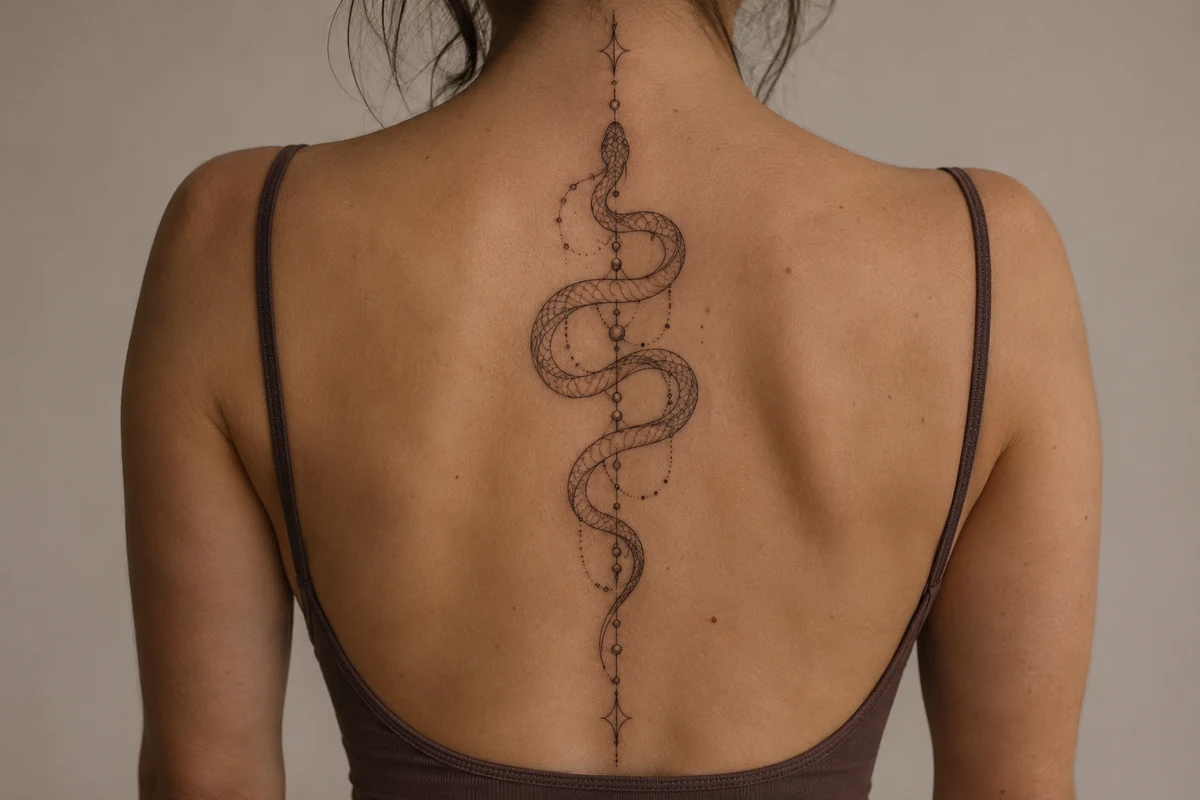
A vertical line of dots runs down the whole spine, and the snake wraps around it like a chain. An elegant design for an open back.
Symbolism: A snake on the spine stands for inner strength that keeps you upright.
Size and pain: what to expect
| Placement | Sensible snake size | Pain (typical) |
|---|---|---|
| Forearm | 10–25 cm (4–10 in) | low–medium |
| Calf | 12–30 cm (5–12 in) | low–medium |
| Upper arm | 10–20 cm (4–8 in) | low |
| Ribs | 15–35 cm (6–14 in) | high |
| Spine / back | 20 cm (8 in) and more | medium–high |
| Ankle, wrist | 5–10 cm (2–4 in), simple designs only | medium |
Rule of thumb: the more scales and head details, the bigger the design has to be. A small snake should be simple.
FAQ: snake tattoo
What does a snake tattoo mean for a woman?
Most often transformation, rebirth, feminine strength and protection. Combined with flowers, also beauty with an edge. The meaning always depends on the context and on what you give it yourself.
Is a snake tattoo bad luck?
There is no single cultural rule against it. In many traditions the snake is a protective and healing symbol, in others a warning. It is a matter of personal interpretation, not a rule.
Where is the best place for a snake tattoo?
Where the snake’s body can stretch out and follow the anatomy: the forearm, calf, along the spine or on the ribs. On short, flat areas, a coiled snake works better.
How long does a snake tattoo take?
A simple fine line snake usually takes one short session. A detailed snake with scales, shading or in Japanese style may need several sessions. Your artist will give you the exact time and price after a consultation.
What does a snake tattoo mean?
Most often transformation and rebirth, because a snake sheds its skin and starts again. In many cultures it also means protection, wisdom and life force, and in the biblical tradition, temptation. The meaning changes with what you add: a flower softens the symbol, a dagger sharpens it, and a snake eating its own tail (the ouroboros) speaks of cycles.
What does a snake tattoo on the arm or forearm mean?
On the arm, a snake most often wraps around the forearm or runs from the wrist to the elbow. This layout emphasizes movement and transformation and is visible every day, so it is often chosen by people who want a symbol of change always in front of them.
Checklist before your consultation
- define your own association and the character of the snake;
- choose the movement: along, around or compact;
- decide which side of the body should show the head;
- give the placement and an approximate size;
- decide whether an extra element is really needed;
- show inspiration for the composition, not a design to copy.
Check the design from every side
Before approving the stencil, turn your arm or leg all the way around and look at the motif in a mirror. With a wrap-around design, one photo will not show the whole composition. Important elements should not disappear in a bend or bunch up on one side.
Next step
Have an idea? Message a tattoo artist
Describe the motif, placement and approximate size in a few sentences, add 2–3 inspiration images and a photo of the spot. With a message like this you will get a specific quote and date much faster.